This male Cheetah was vocalizing to call his brother.
If you want to hear what it sounds go to http://www.youtube.com/watch?v=rtG9Xhqzcf8.
Have a good week!
This male Cheetah was vocalizing to call his brother.
If you want to hear what it sounds go to http://www.youtube.com/watch?v=rtG9Xhqzcf8.
Have a good week!
I did it already 🙂 – Watch this video produced by a Swedish travel company for a “ranger for a while” competition on Thanda.
Truman Ndlovu, Head Guide at Thanda Private Game Reserve, is one of the judges for this exciting competition launch by the Swedish travel company SYDAFRIKARESOR.
In this video Truman introduces the competition and the beauty of Thanda.
To compete go to hoppaavekorrhjulet.se (the site is in Swedish).
Please share this video on Facebook – Thanks
It is not always the Big Five which provide beautiful and special sightings. This Waterbuck bull was looking at us when we drove towards him on Ndlovu Highway. A rare treat.
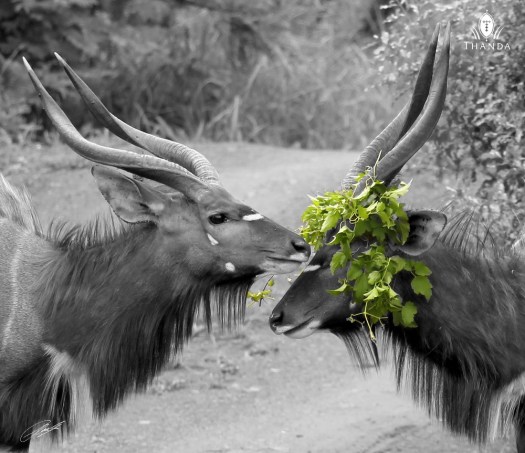
We got many different antelope species on Thanda. Next to Waterbuck we have Impala, Wildebeest, Nyala, Kudu, Duiker, Steenbok and Reedbuck on the reserve.
… and a little special Waterbuck info: Waterbuck and Elephant are the only two large mammal species on Thanda which will not allow Oxpeckers to sit on them and feast on their ticks (see yesterday’s post: https://christiansperka.wordpress.com/2012/11/11/oxpeckers-and-buffalotail/)
The winter (dry season) is predominantly brown and grey. But – as I learn now – when the wet season (summer) starts the bush becomes very colorful.
I took pictures of these nine plants just on one drive from my home to the lodge.
One of my favorite flowers is then one from the Sickle Bush (Dichrostachys cinerea, known also as Bell mimosa, Chinese lantern tree or Kalahari Christmas tree – second from the right/top). The bush itself on the other hand is a real threat to us field guides. The spines on the bush are so hard that they go straight through a tyre and one ends up with a lot of flat tyres when “off-roading” in areas with these bushes!
… and one can see much more reptiles at Thanda. I took this picture around noon when I was driving back from dropping of guests.
This Monitor Lizard (an ectothermic species) was enjoying the sun on one of our main roads. As I approached he decided it was safer in the grass.
About endothermic and ectothermic animals:
There are five major groups of vertebrate animals (fish, amphibians, reptiles, birds, and mammals). One of the differences between these groups is the way their body temperature is controlled.
Mammals and birds have a body temperature that stays about the same no matter what the temperature of their environment is. They are called endotherms. An endotherm is an animal that can control its internal body temperature. Endotherms are called “warm-blooded” animals.
The other three vertebrate groups are often called “cold-blooded” animals. This term is falling out of favor with scientists because it is misleading. They are called, instead, ectotherms. The blood of fish, amphibians, and reptiles is often warm. Their body temperatures are always close to the temperature of their environment.