The South African Kingfishers

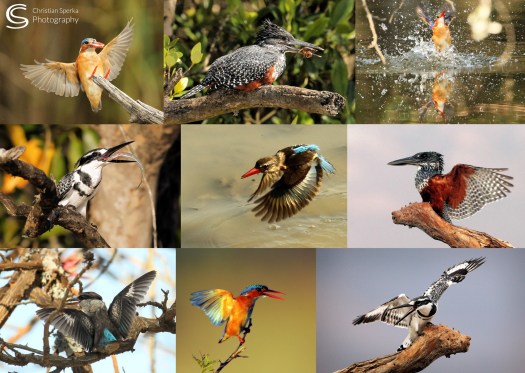
Kingfisher Collage

After yesterday’s post about a Malachite Kingfisher on Thanda a few people have asked me about the various South African Kingfishers. So, here is a short post about them:

There are ten Kingfisher species in South Africa. Five are aquatic species and five are considered woodland Kingfishers. Up til now I took pictures of eight of these ten species. I am still missing the Half-collared Kingfisher and the Grey-headed Kingfisher.

Four of them (Woodland Kingfisher, Striped Kingfisher, Brown-hooded Kingfisher and African Pygmy Kingfisher) are regularly seen on Thanda Safari Private Game Reserve and I had one – rare – sighting of a Malachite Kingfisher. Giant Kingfishers, Mangrove Kingfishers and Pied Kingfishers are aquatic species and are therefore not resident on Thanda.

Enjoy the pictures!

Not supposed to be there! – Bird of the Day – Malachite Kingfisher

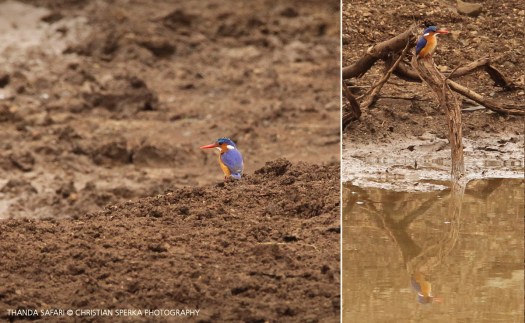
It is always very exciting to see a bird in an area where it usually does not occur. Malachite Kingfishers are one of the aquatic Kingfisher species. They live on Rivers or other large bodies of water. Finding one on Thanda Safari – Private Game Reserve was a very special treat for our bird-loving guests. Bheki (my Zulu tracker) spotted it at the waterhole near my home.

These are not my best Malachite Kingfisher images, but they are very special to me!

To view more of my Malachite Kingfisher images go to http://www.sperka.biz/sgb10
20160325 - CS3_0939 - C - 00

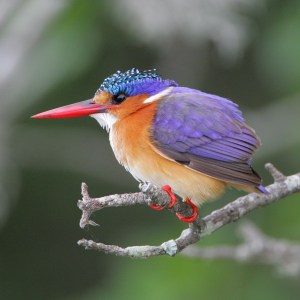
The Malachite Kingfisher (Corythornis cristatus) is an aquatic, small Kingfisher which is widely distributed in Africa south of the Sahara. It is only 13 cm (5.1 in) in length. This species is common to reeds and aquatic vegetation near slow-moving water or ponds. The flight of the Malachite Kingfisher is rapid, with the short, rounded wings whirring until they appear a mere blur. It usually flies low over water. The call of this kingfisher is then a short shrill seek. The breeding song is a chuckling li-cha-cha-chui-chui.
Malachite Kingfisher


On Bheki’s hands …

What is the little creature on my tracker Bheki’s hand. Not the fly, the other one?

What does it eat and how does it hunt?

Let’s see who gets it right!

20150810 - CS3_9785 - E - 00

Bird of the Day – African Paradise Flycatcher

What males will do to attract females 🙂 – The African Paradise Flycatcher males have a very long tail streamer to impress the ladies. This pictures were taken at Mkuze Game Reserve and Thanda Safari – Private Game Reserve, Kwazulu Natal, South Africa.

To view more of my African bird images go to http://www.sperka.biz/sgb

20141225 - CS3_8899 - E - 19

20141225 - CS3_8855 - E - 00

The African Paradise Flycatcher (Terpsiphone viridis) is a common resident breeder in Africa south of the Sahara Desert. The male is boldly colored in chestnut and black and the female is rather more drab. This bird feeds mainly on insects and is usually found in open forests and savannah habitats. The adult male African Paradise Flycatcher is about 17 cm long, but the very long tail streamers double this.

Bird of the Day – Wahlberg’s Eagle

As I am working on the re-organization of my image library I thought to start a series of blogs, which many of you might enjoy. I will present a ‘Bird of the Day’ as often as possible – might not be every day, but we will see how it goes 🙂


This very dark specimen and its mate have a nest near Thanda house. I took this shot trough my office window as the bird sat only a short distance away in the newly cut grass.

To view more of my Wahlberg’s Eagle images go to http://www.sperka.biz/sgb2

Wahlberg’s Eagles (Hieraaetus wahlbergi – named after the Swedish naturalist Johan August Wahlberg) are medium-sized raptors. They are about 53–61 cm (21–24″) in length with a wingspan of 130–146 cm (51–58″) and occur in many color variants from pale and light brown to almost black. They are bird of woodland, often found near water. Wahlberg’s Eagles hunt reptiles, small mammals, and birds.

20160124 - CS1_8523 - E - 00

Reflections

I love the reflections of the ripples in the water on the pelt of the lions.

20150826 - CS1_9779 - C

For the photographers among you: This image was taken at very low light conditions (using a spotlight). It was taken freehand, 300mm, f5.6, eV-2.0, 1/60sec, ISO 6400.

A bloody affair …

When Lions feast on a fresh kill it is rather a bloody affair. This young Lion just got his first share of a Kudu kill.

A strong image showing the rough side of nature!

20150828 - CS1_0216 - C