Moonlight!

End of last month I was lucky to get this image of a Giraffe in front of the rising full moon, 50 minutes after the sun had set.

The picture documents very well the difference between the way human eyes see the world and the way cameras capture it.

Humans are ‘only’ capable of analysing light at the moment it arrives in the eyes (situational). Once our pupils are fully open we get the maximum amount of light possible onto our light recording retina to create (record) pictures in our brain.

Cameras on the other hand can accumulate light over a long time period on a recording sensor and then record it on a memory card. This can turn the night into day. As demonstrated in this long-exposure picture (1.5 seconds) the moon ends up to have a sun-like look and the night sky turns into a golden-blue backdrop for the Giraffe’s silhouette.

Fortunately this large male stood very still for a moment and all of us on my vehicle did not move a muzzle for a few seconds. With the help of a beanbag I was able to position my camera to get this unusual ‘night wildlife images’.

‘Situational’ vs ‘Accumulative’ would be good way to describe the capability difference between the human eyes and a camera.

Technical data: Canon R6 with RF lens f4-6.3/24-240mm | ISO 1600 | 1.5sec | f4 | ev+0 | 24mm | WB 6500K | AV Mode | Crop to 40% of original image

#amazingwildlife #africansafari #safarigetaway #christiansperkaphotography #thandasafari #big5 #gamereserve #wildlifephotography #learnphotography

Street Birds!

I do not often post bird images on this channel as I have a separate birding channel (on WhatsApp, Instagram and Facebook @christiansperkabirding), but I thought I introduce you to twelve colourful birds, which can often be seen on – or next to – roads on a game drive at Thanda Safari. So, here we go (From top left to bottom right):

⁃ Crested Guineafowl (large, chicken-like, and living in groups)

⁃ Fork-tailed Drongo (a small insect-hunter, specialising in following large animals … or cars … to catch stirred-up prey)

⁃ African Hoopoe (very striking looking, and likes sand-bathing in the middle of the road)

⁃ Yellow-throated Longclaw (know for its long claws and bright yellow feathers)

⁃ Red-backed Shrike (one of the easiest ones to spot, sitting on branches in the sun, often on eye level)

⁃ Lilac-breasted Roller (very good insect hunter, mostly to be seen in the dry season)

⁃ Helmeted Guineafowl (another one of the bush chickens with a turkey-like head)

⁃ Crowned Lapwing (a very noisy ground nester)

⁃ Southern Yellow-billed Hornbill (another sand-bather, often to be found displaying on top of trees)

⁃ European Roller (a seasonal visitor, only to be seen in the wet season)

⁃ Burchell’s Coucal (also called the rain bird. Its calls announce rain!)

⁃ Cape Glossy Starling (showing off its beautify blue color only in direct light)

To bring binoculars on safari is most rewarding as one can really enjoy looking closely at the smaller creatures with all their colours and textures. That is why I provide binoculars to every one of my guests on game drive!

No detailed technical data today, but all these images were taken with Canon cameras with either a EF f4/500mm lens or a RF f11/800mm lens

#amazingwildlife #africansafari #safarigetaway #christiansperkaphotography #thandasafari #big5 #gamereserve #wildlifephotography #learnphotography

Rarer than Leopards!

Most people will ask what my excitement is all about when they see this picture.

In my 24 years of photographing wildlife in Southern Africa this is the first time that I was able to take pictures of Greater Cane Rats.

As I drove from my home to Thanda Safari’s base camp a family of these normally nocturnal and very shy creatures ran into the road in front of my car. There were three adults and three pups. Two of them immediately ran into the bushes on the left side of the road, but mum and her little ones were contemplating which side of the road to run to safety.

I used this moment of indecision to get this picture through the windscreen of my car. It is the only Greater Cane Rate image I have ever taken!

Technical data: Canon R6 with RF lens f4-6.3/24-240mm | ISO 100 | 1/750sec | f6.7 | ev-1 | 180mm | WB 6500K | AV Mode

#amazingwildlife #africansafari #safarigetaway #christiansperkaphotography #thandasafari #big5 #gamereserve #wildlifephotography #learnphotography

The Friday Night Spa!

This evening – just before sunset – I have watched an Elephant bull having a great time at a muddy waterhole.

He first drank a bit of water from one of the remaining puddles (this waterhole will be dry soon, if no new rain arrives), followed by a proper mud-wallow.

To my surprise he then proceeded to have a nap for about 10 minutes lying very still in the cooling wet.

Once he finished with his ‘spa treatment’ he proceeded to throw sand on himself, before returning to peaceful gazing away from the water.

Technical data for all three images: Canon R6 with RF lens f4-6.3/24-240mm | ISO 4000 | 1/750sec | f6.7 | ev+0 | 240mm | WB 6500K | AV Mode | cropped

#amazingwildlife #africansafari #safarigetaway #christiansperkaphotography #thandasafari #big5 #gamereserve #wildlifephotography #learnphotography

Technical data: Canon R6 with RF lens f11/800mm | ISO 16000 | 1/500sec | ev+0 | WB 6500K | AV Mode | Crop to 90% of original image
Technical data: Canon R6 with RF lens f11/800mm | ISO 12800 | 1/500sec | ev+0 | WB 6500K | AV Mode | Crop to 25% of original image

A Fast and Nervous Eater

Cheetahs often loose their kill to one of the larger predators (Lion, Hyena, Leopard, …) before they are able to start eating.

After making a kill Cheetahs usually have to recover for a while – heavily panting – before they can start eating. If another predator has heard the sounds made during the hunt they will often come running and deprive a Cheetah of its well earned meal.

So unlike Lions who completely concentrate on eating, Cheetahs will sit up very frequently to look around for approaching danger. They usually start eating very fast from the back side of their prey where they can get a lot of meat in a very short time before a potential arrival of any meat-thieves.

This is a picture I took last night of a young Cheetah female on an Nyala kill eating fast and scanning the area between large gulbs of meats.

Technical data: Canon R6 with RF lens f4-6.3/24-240mm | ISO 5000 | 1/500sec | f6.7 | ev+0 | 150mm | WB 6500K | AV Mode | Crop to 20% of original image

#amazingwildlife #africansafari #safarigetaway #christiansperkaphotography #thandasafari #big5 #gamereserve #wildlifephotography #learnphotography

Technical data: Canon R6 with RF lens f4-6.3/24-240mm | ISO 5000 | 1/500sec | f6.7 | ev+0 | 140mm | WB 6500K | AV Mode | Crop to 50% of original image
Technical data: Canon R6 with RF lens f11/800mm | ISO 16000 | 1/500sec | ev+0 | WB 6500K | AV Mode | Crop to 80% of original image
Technical data: Canon R6 with RF lens f4-6.3/24-240mm | ISO 200 | 1/750sec | f6.7 | ev+0 | 160mm | WB 6500K | AV Mode | Crop to 5% of original image

Dance!

Most antelope males compete for dominance by fighting with their horns or chasing one another around. The winner ends with the mating rights for the contested female(s).

Nyalas have a far less violent method to solve such disputes. While younger bulls are seen regularly fighting with their horn in the common way, older specimen often show a very unusual behaviour.

They circle each other, facing the ground, fluffing up both tails and dorsal manes (white hairs on their back), and arching their heads forward. In this posture they very slowly ‘dance’ around one another.

Whichever one gives up first and walks away seems to be the looser. But I have seen both of them mating with different females soon after the ‘dance’.

I call them the ‘flower power antelope’ being very peaceful and rather free-spirited when it comes to mating 🙂

I took this pictures of two males ‘dancing’ yesterday afternoon.

Technical data: Canon R6 with RF lens f4-6.3/24-240mm | ISO 800 | 1/500sec | f6.7 | ev+0 | 200mm | WB 6500K | AV Mode | Crop to 10% of original image

#amazingwildlife #africansafari #safarigetaway #christiansperkaphotography #thandasafari #big5 #gamereserve #wildlifephotography #learnphotography

Feeding Order!

A few days ago I took these pictures of a few species which feed on a kill in a clearly defined order:

Lions are the actual killers and feed until they are completely full.

Hyenas are the first in the the cleanup crew lineup to work on the carcass.

Jackals are next for the leftovers (and sometimes sneak in for a bite when the Lions and Hyenas are inattentive).

White-backed Vultures and Hooded Vultures fly in once all the four-legged creatures have left. They are often accompanied by large Lappet-faced Vultures (no pictures). Each vulture species‘ beak is designed to support them in their size-dependent role.

And many other birds, like Yellow-billed Kites, Tawny Eagles, Bateleurs, Wolly-necked Storks, and Pied Crows will follow after the vultures.

Technical data: Canon R6 with RF lens f11/800mm | ISO various | 1/500sec | ev+0 | WB 6500K | AV

#amazingwildlife #africansafari #safarigetaway #christiansperkaphotography #thandasafari #big5 #gamereserve #wildlifephotography #learnphotography
Small Kill!

As we drove through some high grass during yesterday evening’s game drive my tracker Bheki collected this fighting pair from our vehicle’s front fender. The small spider and the small Praying Mantis were in a fight for their lives.

When we encountered the two contestants the spider was missing two front legs but he had one of the Praying Mantis’ legs firmly locked in his pincers. We were not sure if the spider lost his legs in this fight or if he entered the contest thus handicapped.

After a few minutes struggle the spider had won and the Praying Mantis had died. It was astonishing how quickly the strong green color faded from the dead creature.

We carefully transferred the winner with his price into a nearby acacia and continued on our drive.

Technical data: Canon R6 with RF lens f4-6.3/24-240mm | ISO 320 | 1/500sec | f6.7 | ev+0.5 | 240mm | WB 6500K | AV Mode | Crop to 5% of original image

#amazingwildlife #africansafari #safarigetaway #christiansperkaphotography #thandasafari #big5 #gamereserve #wildlifephotography #learnphotography
Agile!

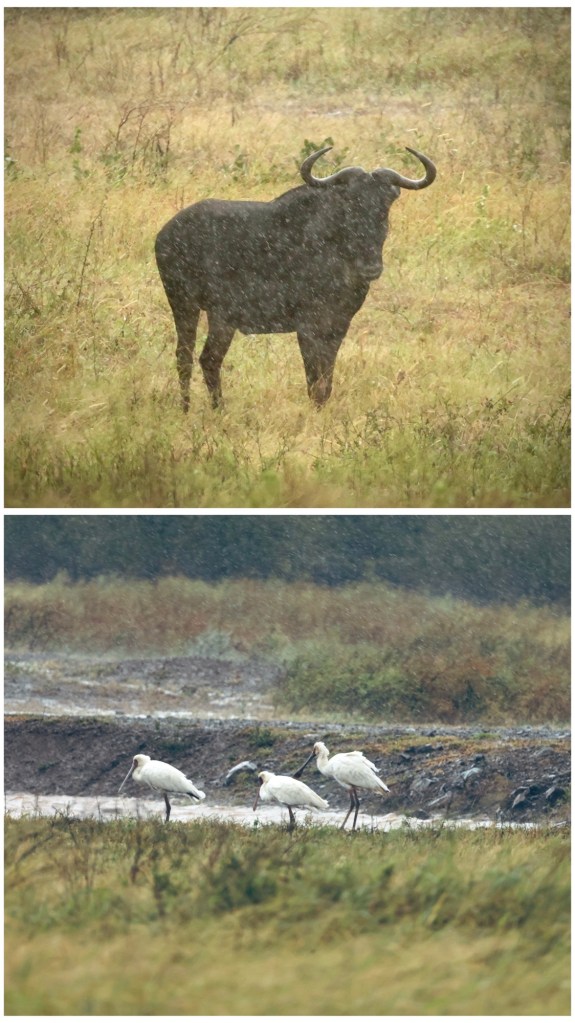
I had no idea how agile a 700kg (1500lbs) Cape Buffalo bull can be. These two beautiful specimens were sparring for a considerable time next to a small Thanda Safari waterhole. After a vigorous display of their agility they settled down to grazing harmoniously.

These two were obviously not with a herd. As they do not appear to be old guys, I assume they were on temporary leave. Once their time-away is over they are likely to rejoin their herd and once again fight with the other bulls for a place in the herd hierarchy.

Technical data: Canon R6 with RF lens f4-6.3/24-240mm | ISO 4000 | 1/2000sec | f5.6 | ev+0 | 90mm | WB 6500K | AV Mode | Crop to 60% of original image

#amazingwildlife #africansafari #safarigetaway #christiansperkaphotography #thandasafari #big5 #gamereserve #wildlifephotography #learnphotography
Zebroids!

Did you know that Zebras can crossbreed with other equine species? When Zebras hybridize, the resulting offspring are called Zebroids. The most common hybrid is the Zorse, a cross between a Zebra and a Horse.

Zebroids often exhibit a combination of traits, such as striped legs and a Horse-like body shape. However, Zebra crossbreeds rarely occur in the wild.

Like mules and hinnies they are generally unable to breed, due to an odd number of chromosomes disrupting meiosis (cell division of germ cells).

Looking at ‘googled’ pictures of Zebroids I am reminded of an extinct relative of modern Zebras, called a Quagga (which still lends its name to the scientific term for today’s Plains Zebra = Equus.quagga).

I took this morning light portrait of this Burchell’s Zebra (Equus quagga burchellii – Southern subspecies of the Plains Zebra) last week on Thanda.

Technical data: Canon R6 with RF lens f4-6.3/24-240m | ISO 2000 | 1/750sec | f6.7 | ev+1 | 160mm | WB 6500K | AV Mode | Crop to 25% of original image

#amazingwildlife #africansafari #safarigetaway #christiansperkaphotography #thandasafari #big5 #gamereserve #wildlifephotography #learnphotography