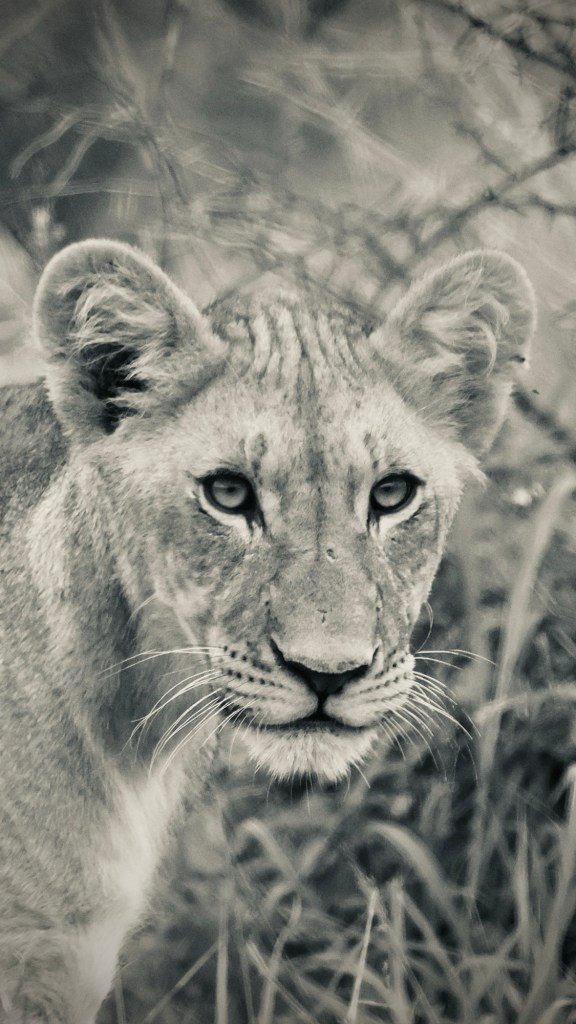
A young Lion portrait is the first wildlife picture I took in 2024.
Four of the boisterous youngsters where with their mum near a waterhole as she was scanning the area for some dinner.
The look on the face of this small male is already the look of a serious cat. Cubs of those age (about 8 months) are still very playful, but with their sharp claws and teeth they can already create serious damage.
Technical data: Canon R6 with RF lens f11/800mm | ISO 4000 | 1/500sec | ev+0 | WB 6500K | AV Mode | Crop to 25% of original image
I took a few days off over Christmas and New Year to visit my family and friends in Germany.
This is a short travel journal with a few iPhone pictures and descriptions of a few of the excellent meals I enjoyed during my visit.
I am back on Thanda Safari as of tomorrow to resume my regular wildlife posts.
22 Dec
I arrived in Zürich, Switzerland, and took a train ride to a town called Frick from where my brother picked me up for the short car ride to my parents place. It was good to see the family again and I had a very restful evening.
23 Dec
A quiet day with a bit of last minute Christmas shopping and ‘the almost’ traditional dinner with my brothers (and this year with my oldest nephew) in the Fuchshöhle (= Fox Hole). This is one of my favorite restaurants in the town of Bad Säckingen (Picture: The catholic church on the town square).
My dinner: Pumpkin creme soup, roasted duck with red cabbage and spätzle, and a superb lime-buttermilk-ice-cream.
24 Dec
I was decorating our Christmas tree and the whole family came together on the evening for a meal and the exchange of Christmas gifts. I got a lot of sweets and chocolate. They must know me!
25 Dec
No white Christmas for me this year. It was rather warm and rainy on Christmas day. Another quiet family occasion (Picture: The view from my parents’ place in Germany looking towards Switzerland).
26 Dec
I went for a very enjoyable walk with some family members around a small lake near the town where I grew up. It was a beautiful sunny day. I needed the exercise after an excellent Chinese lunch and before an Indian dinner. (Pictures: At the Bergsee (=Hill lake)
27 Dec
I had invited all my family (including boyfriends and girlfriend of the younger generation) to a very good Italian lunch. In the afternoon my older nephew, his girlfriend, and I visited the Vitra design exhibition and museum in Weil, Germany. Vitra is a manufacturer of very high end furniture, especially chairs. Worth a visit! (Pictures: The exhibition and me testing one of the comfy chairs)
My lunch: Beef carpaccio, mushroom and onion pizza with salad, and some Italian ice cream
28 Dec
Another rainy day. I worked a bit on my photography of my old model train set pieces for sale on Ebay. In the evening I had a very enjoyable dinner with old friends.
Another walk around the Bergsee. This time it was raining a bit and I got these rather moody pictures. And today was a very special day. It was my parents’ 64th wedding anniversary. We celebrated with a special lunch prepared by my younger brother for this occasion. (Picture: The roses my dad gave to my mum to mark the occasion). And another special dinner with friends from Switzerland in the Fuchshöhle.
30 Dec
My last family dinner for this trip in Germany. This time at an excellent Italian restaurant by the name of Schützengarten (=shooter’s garden). The picture of the day is of a bronze art column in front of the restaurant depicting the city’s history.
My dinner: Beef carpaccio, veal steak with a leek risotto, and panna cotta
31 Dec
A last day with my parents and I left close to mid-night on a flight from Zürich to Johannesburg. I welcomed the New Year 10,000 meters (30,000″) above the ground.
I have returned to Thanda Safari after spending one night in Pretoria. Now I am ready to resume working on wildlife photography.
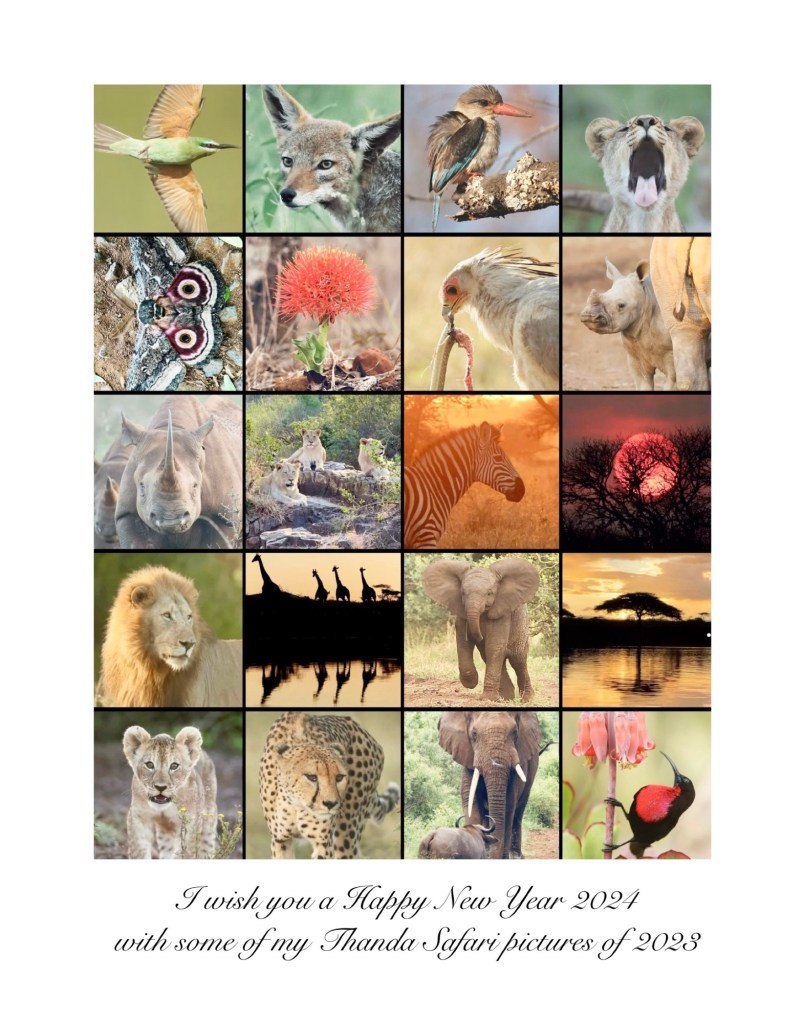
Thanks to all of you for following my posts throughout 2023. This is my last post for this year. I am going to take off until early January to visit my parents, brothers, nieces and nephews in Germany. I will be back with more pictures and stories from the African Wild in 2024.
I wish all of you a Merry Christmas and a Very Happy New Year 2024!
Schöne Ferien!
Vielen Dank an alle, die meine Posts im Jahr 2023 verfolgt haben. Dies ist mein letzter Beitrag für dieses Jahr. Bis Ende Januar werde ich meine Eltern, Brüder, Nichten und Neffen in Deutschland besuchen. Anfang Januar 2024 gibt’s dann wieder Bilder und Geschichten aus der afrikanischen Wildnis.
Ich wünsche Euch allen frohe Weihnachten und ein glückliches neues Jahr 2024!
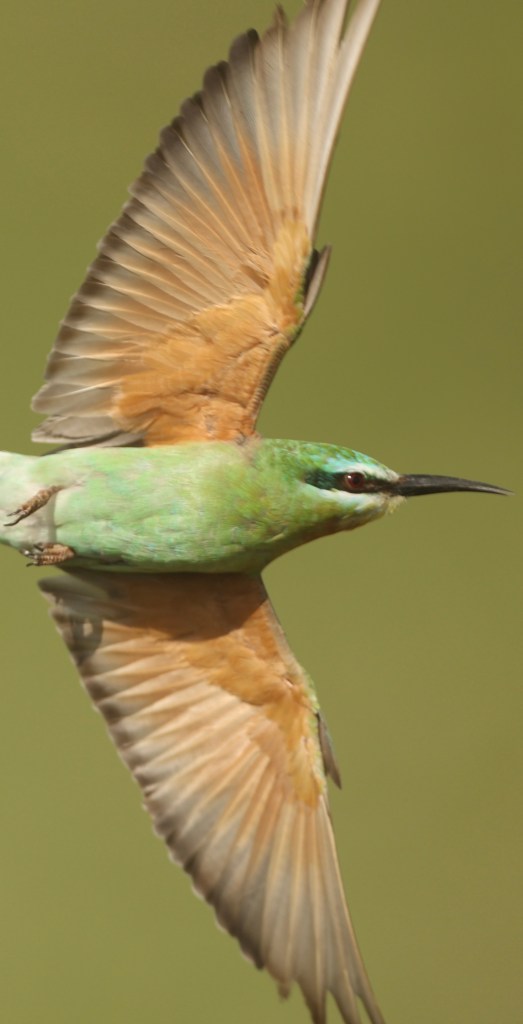
One of my favorite genus of birds is the Bee-eaters (_Merops_). These fast flyers are mainly hunting insect.
As a photographic subject they are especially interesting because many of them have the habit of hunting repeatedly from the same location (eg tree branch) and are returning to the exact same position after their hunt, again and again.
That allows photographers to use manual focus on the departure/arrival location and then shoot fast bursts to get images during take-off and landing. But make sure your shutter speed is 1/2000sec+ as they are very fast. This is how I got the shot of this Blue-cheeked Bee-eater (_Merops persicus_) recently at the iSimangsliso Wetland Park.
10 species of Bee-Earers can be found in Southern Africa (Little, European, White-fronted, Blue-cheeked, Böhm‘s, Northern Carmine, Olive, Southern Carmine, Swallow-tailed, White-throated). The first four have been sighted on Thanda.
_Technical data: Canon R6 with EF lens f4.0/500mm | ISO 200 | 1/3000sec | f4 | ev0| 500mm | WB 6500K | AV Mode | Crop to 30% of original image | hand-held_
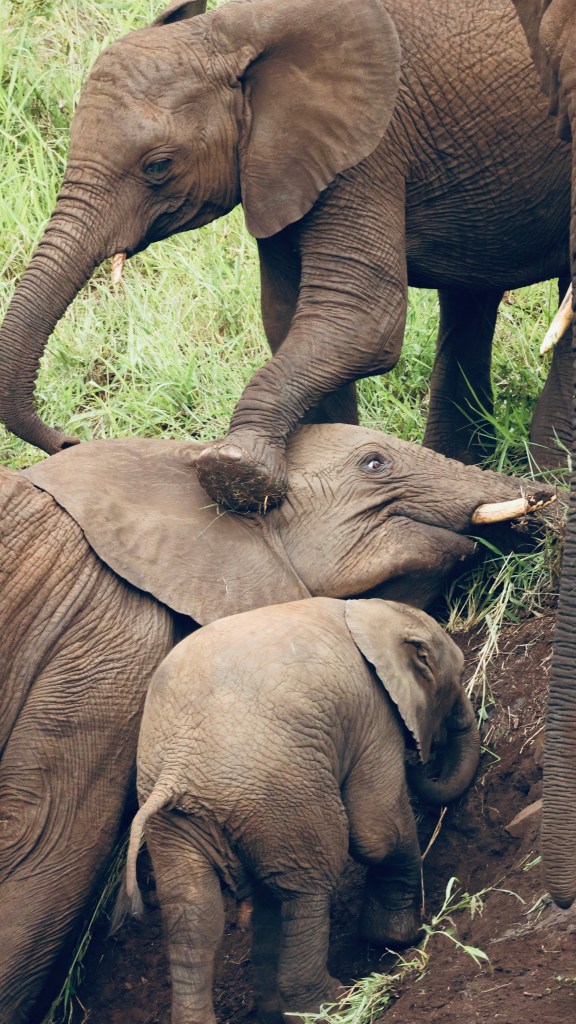
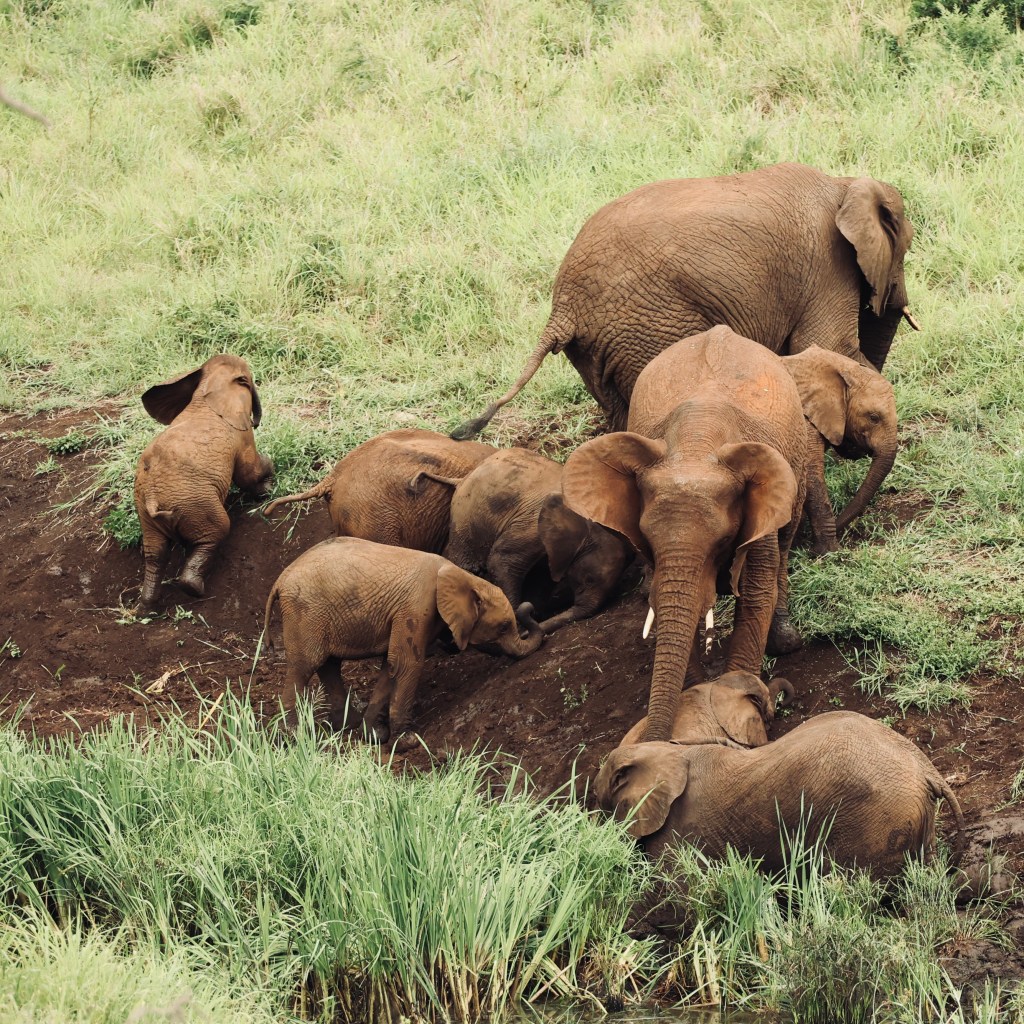
Baby Elephants are very cute to watch. Even when they are still quite small they like to play hard, especially if they encounter a muddy patch. These two youngster had a great time while their tolerant elders watched over them.
Baby Elephants weight between 90 and 120kg (200-260lbs) at birth. Most of all births happen at night, after a 22 months gestation period.
Technical data: Canon R6 with RF lens f11/800mm | ISO 4000 | 1/500sec | ev+0 | WB 6500K | AV Mode | Crop to 35% of original image | hand-held | Image taken at 12:30 midday
Yesterday morning I went on a short excursion to the iSimangaliso Wetland Park (www.isimangaliso.com), one of my favourite places in KwaZulu Natal. I mainly went to do a bit of bird photography but I also captured two true wetland specialists in one shot.
Great Egrets are waders who hunt for their prey in shallow waters. They are the largest white Egret, about the same size as a Grey Heron.
Waterbucks are an antelope species very well adapted to wet, marshy areas. An oily substance prevents them from getting hoof rot, even when standing for a long time on wet ground.
Technical data: Canon R6 with RF lens f11/800mm | ISO 100 | 1/500sec | ev-0.5 | WB 6500K | AV Mode | Crop to 80% of original image
Human tears are often associated with emotions. These can be tears of joy or sorrow.
African Elephants have temporal glands between their eyes and their ears (males and females). When they secret a dark, oily, musky liquid it is usually a sign for them being in a special emotional state. This can be sexual (especially with Elephant bulls in musth), but it can have many other reasons, like being a sign of distress when running into Lions, or being a sign of excitement when meeting up with another Elephant group.
Half an hour ago I took this picture of a young bull who started secreting from the gland after a sparring session with another bull. But his dry back legs would indicated that he is not in musth. Musth bulls have to get rid of their excess testosterone by constantly dribbling urine and have therefore wet legs.
Technical data: Canon R6 with RF lens f11/800mm | ISO 64000 | 1/500sec | f11 | ev+0 | 800mm | WB 6500K | AV Mode | Crop to 90% of original image
I often get asked why African Lion, Leopard, African Elephant, Black Rhino, and Cape Buffalo are called the ‘Big Five’. It is not a modern marketing term as many suspect, it is an old hunting term. These five mammals are the most dangerous to hunt on foot. Whereas most animals will run away when confronted by Humans, the Big Five will often rather attack, especially if a hunter injures them, but does not manage to kill them.
The two most dangerous of these five to encounter are Black Rhinos and Cape Buffalo bulls (either solitary or in small groups, called Dugga Boys). When confronted by Humans they will often attack without any warning. Most other mammals (including Lions and Elephants) will either run away or try to warn their opponent to back off before a possible attack.
This is a Dugga Boys picture of two taken from my Suzuki Jimny. On Thanda Safari our Buffalo are quite used to vehicles, which allowed me to lower my window and get this close-up portrait. I could feel the breath of first bull on my hand while holding the phone.
Note: I recommend not to get that close to Cape Buffalo if you do not know the temperament of the individuals you’re looking at (for example when driving yourself in a National Park). As with Black Rhinos (see yesterday’s post) a close encounter could lead to a lot of work for your panel beater!
Technical data: Apple iPhone 14 Pro Max | Main Camera | 24mm / f1.78 | ISO80 | cropped to 80 of the original image | Shot taken at 7:00am
I get often asked to characterized the two Rhino species in South Africa and I frequently use a dog comparison to illustrate the difference in temperament.
White Rhinos (or better Square-lipped Rhinoceroses) are very large (Average 1400-2300kg/3000-5000bs). They are normally quite relaxed around safari vehicles and, in case they get upset, they usually just run away rather than attack a possible opponent. So they are more like Saint Bernhard dogs, large with a calm temperament.
Black Rhinos (or better Hooked-lipped Rhinoceroses) are much smaller (Average 800-1400kg/1750-3000lbs) than their cousins. But as Pit Bulls they are always on edge and ready to fight. They have a very nervous temperament as they usually live in thick bush and get easily surprised by other creatures. When faced with a vehicle they often perform warning charges (also called mock charges) to intimidate their possible opponent and to figure out what is going on. I think it is prudent only to stay around for maximum two of these warnings (and take your pictures). If the Black Rhino finds you still there after two charges (for smelling and listing) it might come in for a bit of touching, which could end up in a badly damaged car (and even worse in a hurt Rhino).
I met this Black Rhino bull on Sunday when I drove with my Suzuki Jimmy along a main road. Being on eye-level was no problem and I took a few picture with my iPhone during two short warning charges, before he and I decided to move along!
Technical data: Apple iPhone 14 Pro Max | Telephoto Camera 3x | 77mm | f2.8 | ISO80 | 1/100sec | cropped to 50% of the original image | Shot taken at 5:45am








 Christian Sperka Photography | Custom Luxury Tours