
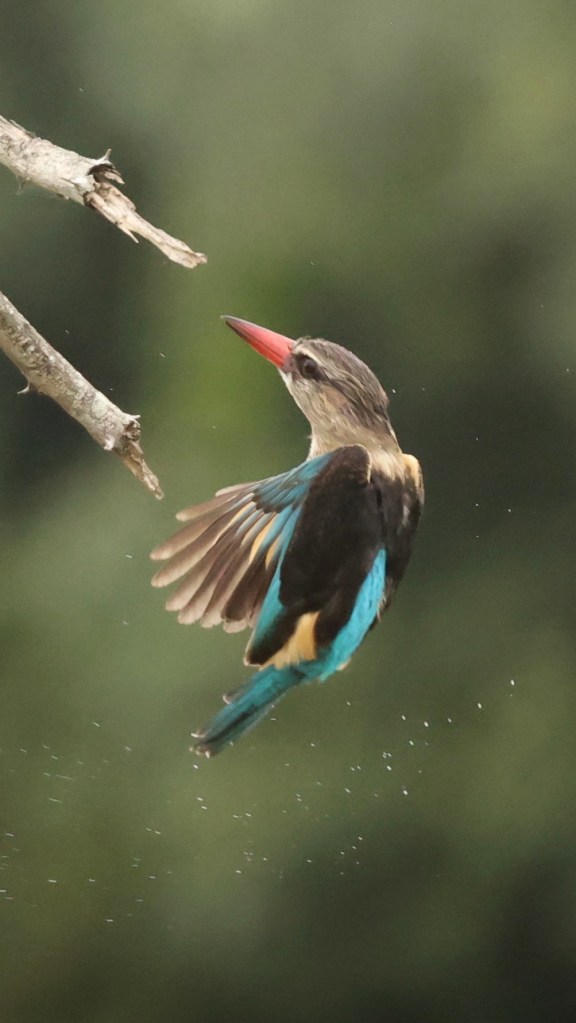
Photographing birds in flight is quite challenging, but Kingfishers and Bee-eaters make it somewhat easier due to their hunting and bathing behaviors.
Both Kingfishers (with 10 different species in Southern Africa) and Bee-eaters (also with 10 different species) enjoy perching on trees to hunt or bathe. Additionally, they frequently return to the same branch after flying off to catch an insect or dip into the water.
Here is a brief guide on capturing in-flight birds before landing:
1. Place the camera on a beanbag or a tripod.
2. Set your shutter speed to 1/2000 second or faster.
3. Switch the camera to manual focus and ensure you do not touch the focus ring.
4. Set the camera to ‘continuous shooting mode’ with the highest frame rate available.
5. Frame and focus on the perched bird, leaving enough room for aerial landing images.
6. Wait for the bird to depart for its hunt or bath without looking through the viewfinder but watch the bird instead.
7. Begin shooting as the bird returns towards the perch, continuing until it is stationary again. Be sure to press the shutter button gently to avoid moving the camera from its target area.
8. Review your images (I typically shooting 20-40 frames for one landing) and select the best ones.
This process requires patience. For the Brown-hooded Kingfisher landing in the picture, I captured seven approaches with a total of 197 images taken, resulting in a satisfying outcome (and as you can see from the droplets in the air he returned from a bath).
Technical data: Canon R6 with RF lens f11/800mm | ISO 10000 | 1/3000sec | ev+0 | WB 6500K | AV Mode | Cropped to 10% of the original image.
For more stories and pictures, visit my blog at https://sperka.info/blog/.
#amazingwildlife #africansafari #safarigetaway #christiansperkaphotography #thandasafari #big5 #gamereserve #wildlifephotography #learnphotography



 Christian Sperka Photography | Custom Luxury Tours