
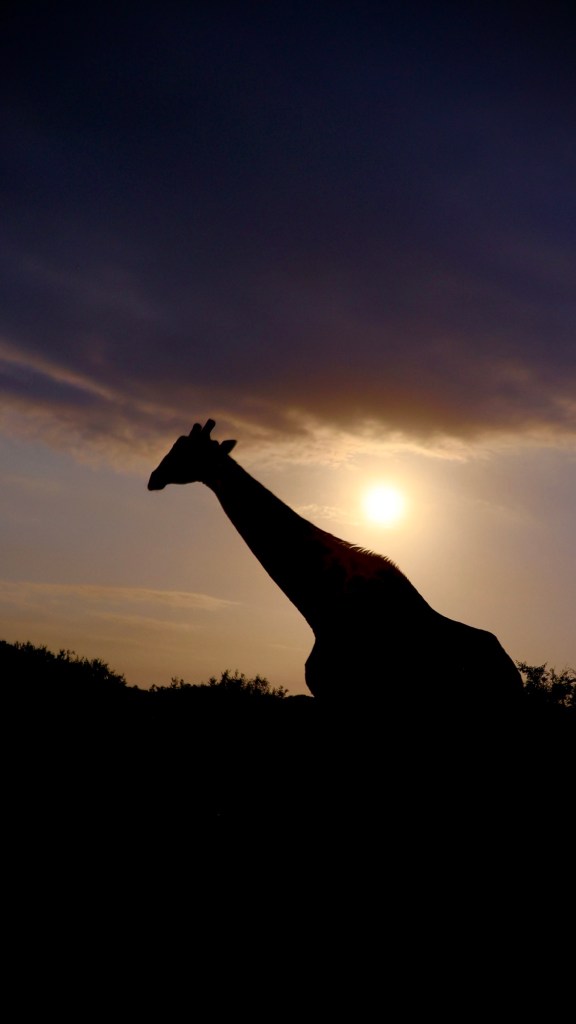
End of last month I was lucky to get this image of a Giraffe in front of the rising full moon, 50 minutes after the sun had set.
The picture documents very well the difference between the way human eyes see the world and the way cameras capture it.
Humans are ‘only’ capable of analysing light at the moment it arrives in the eyes (situational). Once our pupils are fully open we get the maximum amount of light possible onto our light recording retina to create (record) pictures in our brain.
Cameras on the other hand can accumulate light over a long time period on a recording sensor and then record it on a memory card. This can turn the night into day. As demonstrated in this long-exposure picture (1.5 seconds) the moon ends up to have a sun-like look and the night sky turns into a golden-blue backdrop for the Giraffe’s silhouette.
Fortunately this large male stood very still for a moment and all of us on my vehicle did not move a muzzle for a few seconds. With the help of a beanbag I was able to position my camera to get this unusual ‘night wildlife images’.
‘Situational’ vs ‘Accumulative’ would be good way to describe the capability difference between the human eyes and a camera.
Technical data: Canon R6 with RF lens f4-6.3/24-240mm | ISO 1600 | 1.5sec | f4 | ev+0 | 24mm | WB 6500K | AV Mode | Crop to 40% of original image
#amazingwildlife #africansafari #safarigetaway #christiansperkaphotography #thandasafari #big5 #gamereserve #wildlifephotography #learnphotography


 Christian Sperka Photography | Custom Luxury Tours