Invitation to the March Gallery Crawl / Picture of the Week 9 – Bubble Bath!

[View all Pictures of the Week 2012]
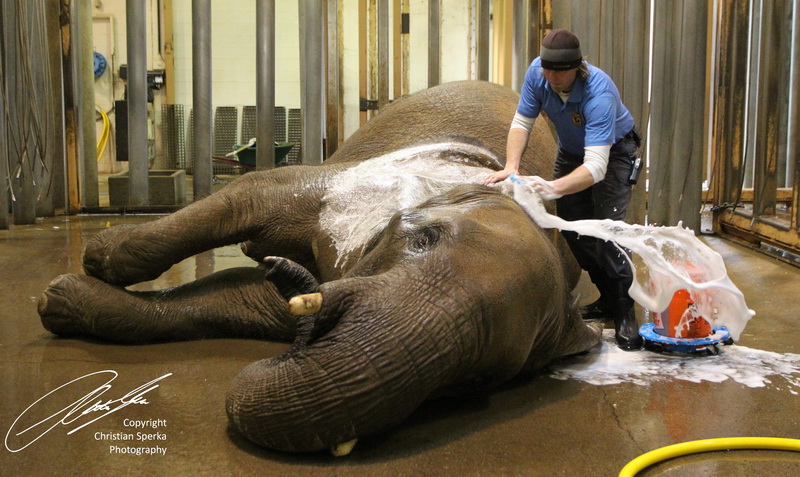
It is not really a bubble bath but Hadari, one the Nashville Zoo’s African Elephants, is getting a “shampoo rub down”  as part of her daily routine.

Invitation to the March Gallery Crawl

When: Saturday, March 3, 2012 from 6p.m. to 9p.m.
Where: Christian Sperka Photography / Animal Art Photography Gallery at the Arcade [Downtown Nashville in the block between Church and Union Streets and 4th and 5th Avenues]

Special Event
INTELLIGENT GIANTS – The Nashville Zoo Elephants

In cooperation with the Nashville Zoo I will be presenting many interesting  images and video clips of the Nashville Zoo Elephants.

I will show a lot of backstage images give some insights into Elephant care at Nashville Zoo at Grassmere.

There will be three presentations by Connie Philipp, Director of Animal Collections (at 6:30pm / 7:30pm and 8:30pm) on the subject.

I am looking forward to seeing you on Saturday 🙂
Picture of the Week 8 – An “Unhappy” Lady

[View all Pictures of the Week 2012]

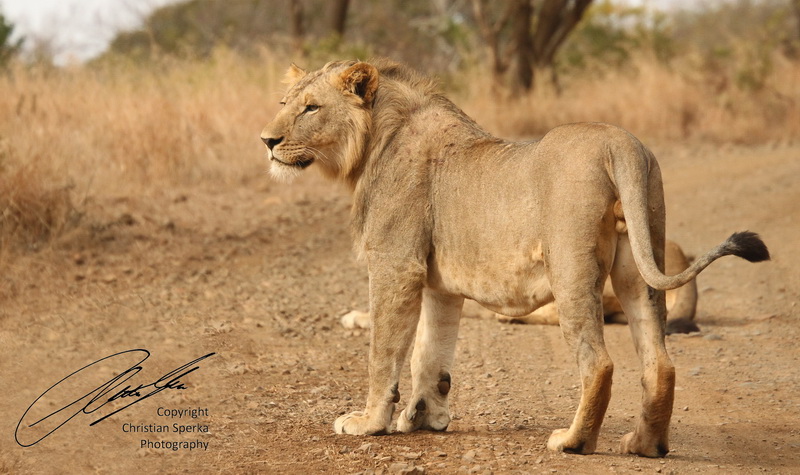
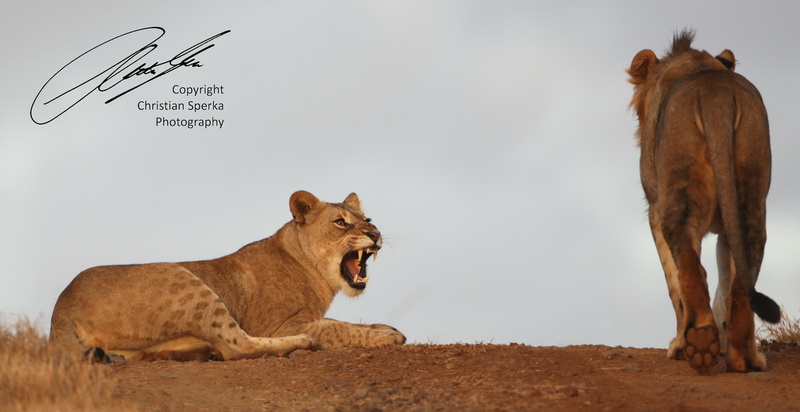
Most of the time you see a picture of a lion with an open mouth the animal is either yawning or flehming. It may look threatening and intimidating but it really is neither.

The young lioness in this pictures shows that she is quite upset. She is growling  at two young males (one of them in the picture), which were part of a different pride, who walked quietly past her in a show of dominance.

This scene was part of an encounter of the juvenile offspring from two prides on Thanda Private Game Reserve (2 males and one female on both sides). This happened while the adult females of each pride were absent.

During the time we watched the encounter there were no open hostilities, just lots of territorial marking behavior, many growls and fierce facial expressions (as the one in the picture 🙂

But the next day the males of both prides showed obvious signs of a night battle (wounds from claws on his shoulder – see the picture below).

More about lions:

Both males and females defend the pride and its territory against intruders. The male(s) associated with the pride must defend their relationship to the pride from outside males who attempt to take over their relationship with the pride. Females form the stable social unit in a pride and do not tolerate outside females. Membership only changes with the births and deaths of lionesses, although some females do leave and become nomadic and/or form a new pride. Sub-adult males on the other hand, must leave the pride when they reach maturity at around 2–3 years of age.

Picture Data:

Picture 1: Camera: Canon 1Ds MIII / Lens: Canon L 4.0 500mm / Mode: AV / Shutter Speed: 1/500s / Aperture: f/4 / ISO: 400 / Exposure Correction +1eV / Metering: Central weighted / White balance: manual K6500 / Time: midday / Freehand

Picture 2: Camera: Canon 1D MIV / Lens: Canon L 3.5-5.6 28-300mm at 210mm / Mode: AV / Shutter Speed: 1/4000s / Aperture: f/5.6 / ISO: 1600 / Exposure Correction +0.5eV / Metering: Central weighted / White balance: manual K6500 / Time: mid morning / Freehand

For more Lion pictures got to
www.sperka.biz/lion (for African Lion)
www.sperka.biz/lion2 (for African Lion in zoos)
www.sperka.biz/lion3 (for Asiatic Lion)

Picture of the Week 7 – Browsing in the Rain!

[View all Pictures of the Week 2012]

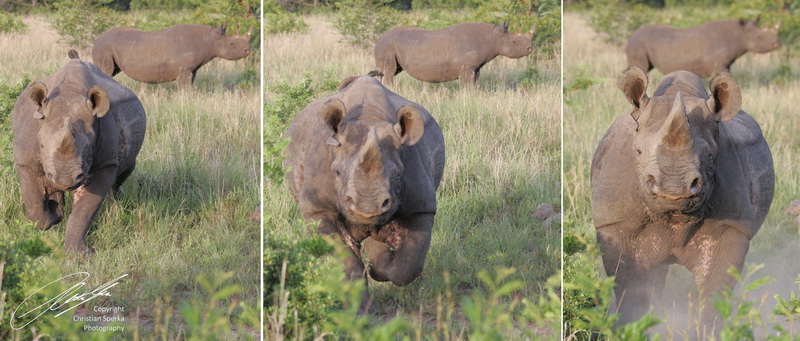
This is a picture of a Black Rhino browsing in the rain at Phinda Private Game Reserve, Kwazulu Natal, South Africa.

If you would like to order a print of this image go to http://www.sperka.biz/potw2012/h31e582f6#h31e582f6

The first time I took pictures of a Black Rhino mock-charging our car I did not take pictures 🙂  My adrenaline level was high and I had visions of a horn coming through the side of the car.  But, after a few of these “show” attacks I was able to get these pictures.

For more Black Rhino pictures go to www.sperka.biz/blackrhino

Picture Data (Browsing in the Rain):
Canon 1D Mark II, Canon L 100-400mm at 400mm, Freehand from vehicle, Mode AV, ISO 800, f/5.6, 1/125sec, Exposure compensation +/-0eV, AWB, Focus center point only

About Black Rhinoceros:
The Black Rhinoceros or Hook-lipped Rhinoceros (Diceros bicornis), is a species of Rhinoceros, native to the eastern and central areas of Africa including Kenya, Tanzania, Cameroon, South Africa, Namibia, Zimbabwe, and Angola. The species overall is classified as critically endangered, and one subspecies, the Western Black Rhinoceros, was declared extinct by the IUCN in 2011.

An adult Black Rhinoceros stands 132–180 cm (52–71 in) high at the shoulder and is 2.8–3.8 m (9.2–12 ft) in length. An adult typically weighs from 800 to 1,400 kg (1,800 to 3,100 lb), however unusually large male specimens have been reported at up to 2,900 kg (6,380 lb).

Females are smaller than the males. Two horns on the skull are made of keratin. These horns are used for defense, intimidation, and digging up roots and breaking branches during feeding. The Black Rhino is smaller than the White Rhino, and has a long, pointed, and prehensile upper lip, which it uses to grasp leaves and twigs when feeding.

Picture of the Week 6 – Stare!

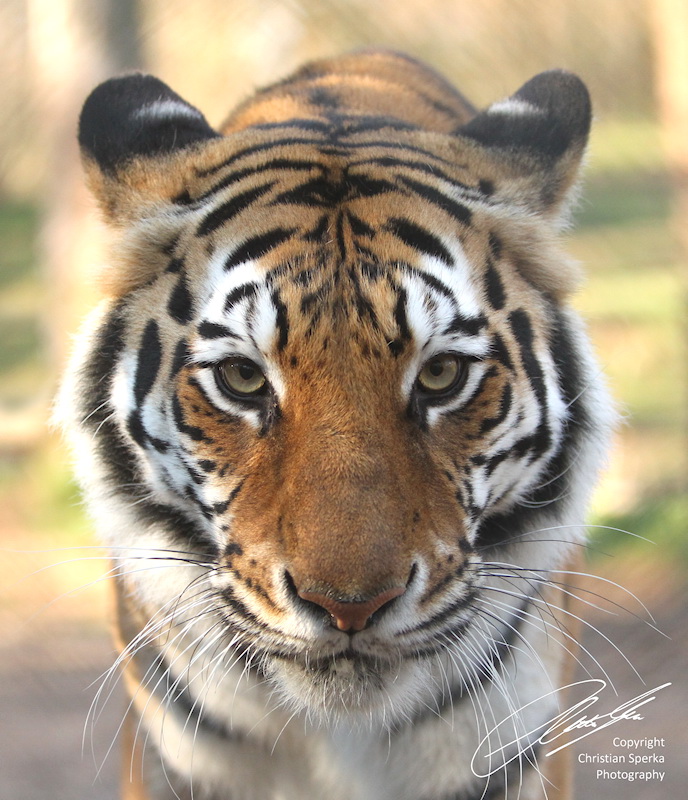
Female Bengal Tiger (Panthera tigris tigris) Deutsch:Koenigstiger

[View all Pictures of the Week 2012]

A direct stare of a fully grown tiger from a few feet away is making you feel a bit squeezy in the the stomach, even if you know that you are safe behind the fence.

I took this picture last week at Nashville Zoo at Grassmere as part of a series of “eye level” Bengal Tiger pictures.

Here are the technical details (for the photographers among you :-): The shot was taken through chain-linked fence with the lens a few inches from the fence. The chain link openings were only 2/3 of the lens diameter. The animal was moving at the time towards the camera (lens 70mm – aperture f/2.8 – shutter speed 1/1500sec – ISO 1600 – aperture control mode – continous focus mode – central focus point only – exposure compensation +/-0 – crop approx.50%).

If you would like to purchase a print of this image go to http://www.sperka.biz/p50955839/h7b49fb1#h7b49fb1

Eyes Series Version:

For more Tiger pictures:

Bengal Tiger (Nashville Zoo) – www.sperka.biz/nztiger
Bengal Tiger – www.sperka.biz/bengaltiger
Malayan Tiger – www.sperka.biz/malayantiger
Amur Tiger – www.sperka.biz/amurtiger

If you would like know more about the conservation efforts for Tigers go to Panthera’s Tiger projects webpage: http://www.panthera.org/species/tiger

About Tigers:

The Tiger (Panthera tigris) is the largest cat species, reaching a total body length of up to 3.3 metres (11 ft) and weighing up to 306 kg (670 lb). Their most recognizable feature is a pattern of dark vertical stripes on reddish-orange fur with lighter underparts. Tigers once ranged widely across Asia, from Turkey in the west to the eastern coast of Russia. Over the past 100 years, they have lost 93% of their historic range, and have been extirpated from southwest and central Asia, from the islands of Java and Bali, and from large areas of Southeast and Eastern Asia. Today, they range from the Siberian taiga to open grasslands and tropical mangrove swamps.

The remaining six Tiger subspecies (Bengal Tiger, Indochinese Tiger, Malayan Tiger, Sumatran Tiger, Amur or Siberian Tiger, South China Tiger) have been classified as endangered by IUCN. The global population in the wild is estimated to number between 3,000 to 4,000 individuals, with most remaining populations occurring in small pockets that are isolated from each other. Major reasons for population decline include habitat destruction, habitat fragmentation and poaching.

Picture of the Week 5 – Scare and Intimidate

Eurasian Eagle Owl (Bubo bubo)Deutsch: Uhu

[View all Pictures of the Week 2012]

One of my favorite birds at Nashville Zoo is this Eurasian Eagle Owl.

His name is Archimedes. He is one of the education animals at the zoo and he appears regularly on stage as part of the education animal shows and in the zoo’s outreach programs.

In this picture Archimedes showed his full beauty in a defensive posture as he sighted a young Lynx cub near by.

For more owl images go to http://www.sperka.biz/eeowl.

About Eurasian Eagle Owls

The Eurasian Eagle Owl (Bubo bubo) is a very large and powerful bird. It is often referred to as the world’s largest owl, although Blakiston’s Fish Owl is slightly heavier on average and the Great Grey Owl is slightly longer on average.

The Eagle Owl has a wingspan of 138–200 cm (55–79 in) and measures 58–75 cm (23–30 in) in heights. Females weigh 1.75-4.5 kg (3.9-10 lbs) and males weigh 1.5-3.2 kg (3.3-7 lbs). In comparison, the Great Horned Owl, roughly the Eagle Owl’s ecological equivalent in North America, weighs around 1.4 kg (3.1 lbs). The great size, ear tufts and orange eyes make this a distinctive species.

Eagle Owls are distributed sparsely through a wide range of habitats. They have been found in habitats as diverse as Northern coniferous forests to the edge of vast deserts. Rocky areas seem to be favored, with cliffs and mountains abutting woodland usually containing the largest numbers of these owls.

And the winners are …

Emily Helms, Keith Pruitt and Steve Brenner. Congratulations!

All winners will receive a 11″x14″ animal art print of their choice.

Not Camera Shy! – Picture of the Year 2011

184 people have voted and the clear winner (with 24 votes) is the picture of the week 23 (A Clouded Leopard cub at Nashville Zoo at Grassmere trying to touch a camera during a news media introduction – Title: Not Camera Shy!).

On second place is the picture of the week 49 (A Orangutan baby holding on to its mum – Title: Hold On! / 11 votes)

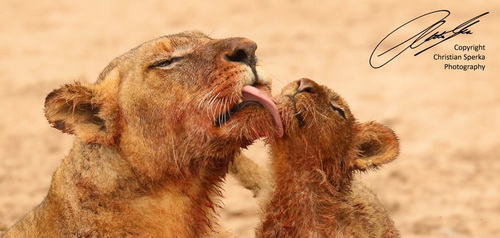
On third place is the picture of the week 35 (A Lioness cleaning her cub after a big giraffe meal – Title: Wash! / 10 votes)

Thanks to everyone who voted and helped selecting the picture of the year 2011.

The picture of the year image is available as a print (4″x6″ or 8″x10″) in the Nashville Zoo gift shop or online at www.sperka.biz/poty2011.

If you would like to review all pictures of the week 2011 got www.sperka.biz/potw2011.

For the pictures of the week 2012 go to www.sperka.biz/potw2012.

Picture of the Week 4 – Evening Patrol!

[View all Pictures of the Week 2012]

Leopards are my favorite species of cats!

Since 2002 I am supporting a leopard conservation project in South Africa. It is called the Munyawana Leopard Project.

This week’s picture is of one of the female project leopards walking the boundries of her territory at dusk.

If you like to know more about this project and the organisation which runs the project go to www.panthera.org/programs/leopard/munyawana-leopard-project.

If you like to see more of my pictures taken for the project go to www.sperka.biz/mlp.

For more leopard images from my various trips to southern Africa go to www.sperka.biz/leopard.

About Leopards:

The Leopard (Panthera pardus) is the smallest of the four “big cats” in the genus Panthera, the other three being the tiger, lion, and jaguar. It was once distributed across eastern and southern Asia and Africa, from Siberia to South Africa, but its range of distribution has decreased radically because of hunting and loss of habitat. It is now chiefly found in sub-Saharan Africa; there are also fragmented populations in the Indian subcontinent, Sri Lanka, Indochina, Malaysia, Indonesia, and China. Because of its declining range and population, it is listed as a “Near Threatened” species on the IUCN Red List.

Compared to the other “big cats”, the leopard has relatively short legs and a long body with a large skull. Both leopards and jaguars that are melanistic (completely black or very dark) are known as black panthers. The species’ success in the wild is in part due to its opportunistic hunting behavior, its adaptability to habitats, its ability to run at speeds approaching 58 kilometres per hour (36 mph), its unequaled ability to climb trees even when carrying a heavy carcass, and its notorious ability for stealth.

ONLY ONE DAY LEFT – Vote for your Picture of the Year 2011 and win an Art Print

PLEASE VOTE FOR THE PICTURE OF THE YEAR 2011 by sending an email to INFO@SPERKA.COM. Thanks you.

Select from  http://www.sperka.biz/potw2011.

Same procedure as last year 🙂 Please select your Picture of the Year 2011 from all my Pictures of the Week in 2011. You can review the pictures at http://www.sperka.biz/potw2011. Then either send me an email, a blog message or a facebook message with your choice of image.  The voting process is open until the end 20th of January 2012.

I will draw two winners from the group of people who voted for the winner image (with the most votes). I will also draw one winner from all people who voted regardless for which image. All three winners will get one Christian Sperka Art Print (11″x14″) with an image of their choice for free.


Picture of the Week 3 – Determined!

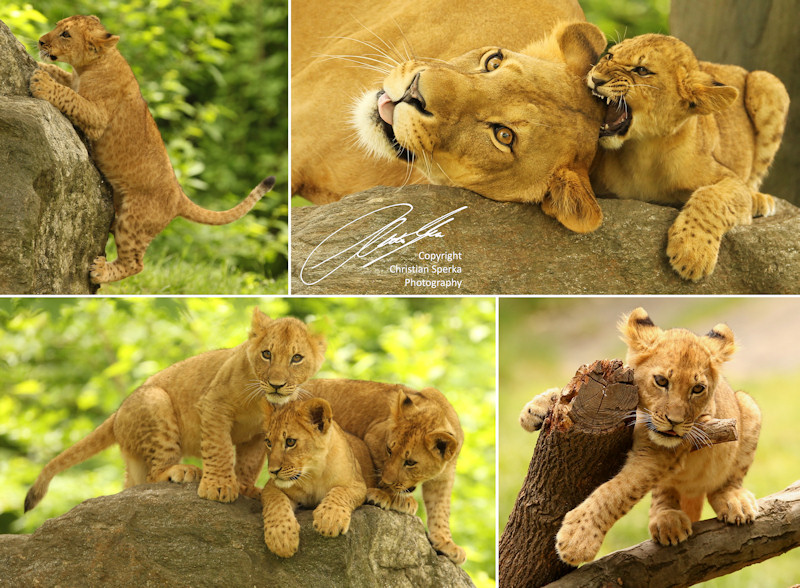
This small Lion cub was playing very determinedly with the piece of wood.
The picture was taken at The Bronx Zoo in New York.

[View all Pictures of the Week 2012]


Determined by Christian Sperka

For more Lion pictures got to
www.sperka.biz/lion (for African Lion)
www.sperka.biz/lion2 (for African Lion in zoos)
www.sperka.biz/lion3 (for Asiatic Lion)

[If you would like to order a print of this images online click here] 

About lions:

Lions (Panthera leo) are one of the four big cats in the genus Panthera. With some males exceeding 250 kg (550 lb) in weight, it is the second-largest living cat after the tiger. Wild Lions currently exist in Sub-Saharan Africa and in Asia with an endangered remnant population in Gir Forest National Park in India, having disappeared from North Africa and Southwest Asia in historic times.

Lions are a vulnerable species, having seen large, possibly irreversible, population decline over the past two decades in its African range. Lion populations are untenable outside designated reserves and national parks. Although the cause of the decline is not fully understood, habitat loss and conflicts with humans are currently the greatest causes of concern. 

Lions live for ten to fourteen years in the wild, while in captivity they can live longer than twenty years. In the wild, males seldom live longer than ten years, as injuries sustained from fighting with rival males greatly reduce their longevity. Zoos are cooperating worldwide in breeding programs for the endangered Asiatic subspecies (See my pictures of the Asiatic Lions at the Zurich Zoo in Switzerland).

Lions at The Bronx Zoo in New York.

Picture of the Week 2 – View Point

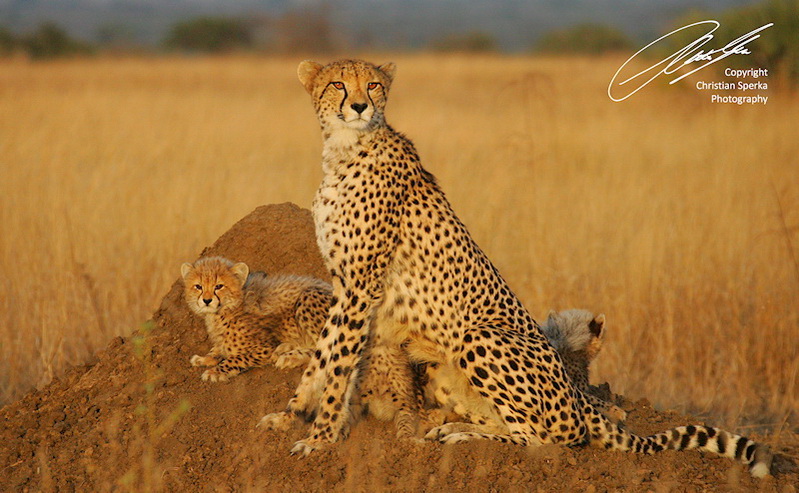
Cheetahs are one of my favorite cats. In 2005 I had the opportunity to follow a Cheetah mom and her four cubs for three days. I got many beautiful shots from these days. This week’s picture was never published before. Enjoy it!

View Point – A Cheetah with her cubs resting on a termite hill looking for prey on Mziki Marsh – Phinda Private Game Reserve – South Africa.

For more Cheetah pictures got to www.sperka.biz/cheetah.

If you would like to order a print of this images online go to http://www.sperka.biz/potw2012/h2ba335ce#h2ba335ce

About Cheetahs:
The Cheetah (Acinonyx jubatus) is a large-sized cat inhabiting most of Africa and parts of the Middle East.  It is the only cat with non-retractable claws (therefore cheetahs cannot climb vertical trees, although they are generally capable of reaching easily accessible branches). It achieves by far the fastest land speed of any living animal—up to 120 km/h (75 mph) in short bursts covering distances up to 500 m (1,600 ft), and has the ability to accelerate from 0 to over 100 km/h (62 mph) in three seconds.

The cheetah has unusually low genetic variability. It is thought that the species went through a prolonged period of inbreeding following a genetic bottleneck during the last ice age. The extinct genus Miracinonyx was extremely cheetah-like, but recent DNA analysis has shown that Miracinonyx (early to late Pleistocene epoch), found in North America and called the “North American cheetah” are not true cheetahs, instead being close relatives to the cougar.