I took aerial pictures of staff members forming a heart to celebrate twenty years of Thanda Safari.
I have been working at Thanda for almost twelve years now, and I am proud to call it my home Let’s hope I will make it to my 20-year anniversary at Thanda 🙂
On the weekend we found this very young Cape Buffalo calf and its mum. The little one stayed very close to its mother, who still showed all the signs of a recent birth.
It is very important for the calf to get licked and nuzzled by mum and lick and nuzzle mum. It creates a bond that is important for them to identify one another within a herd.
We observed them for a while and I was fascinated by the big eyes in the small head 🙂
Technical data: Canon R6 with RF lens f4-6.3/24-240mm | ISO 2000 | 1/500sec | f6.3 | ev+0 | 150mm | WB 6500K | AV Mode
Have a good week 🙂
PS: I will be on a trip to Europe from end of this week until mid of June. My wildlife blogs/posts will resume on 17 June.
This morning, Thanda Safari published the official release for THE ROYAL THANDA CLUB.
I am proud to have contributed many pictures to the project and I am looking forward to providing my photographic services to the future guests of The Royal Thanda Club.
Please take a look at the fact sheet and brochure (links below) for these incredible new villas with their stunning views of the Rolling Hills of Zululand!
… are noted for the impressive webs they weave. There are quite a few different species in the genus _Trichonephila_. The females can reach sizes of over 5cm (2″). The males are usually 2/3 smaller.
This picture shows what one can close-up work one can do with a good smart phone.
Technical data: Apple 14 Pro Max | Main Camera 48mm | ISO 80 | 1/85sec | f1.8 | ev+0 | 240mm
When a pride of lions has many juvenile members, the experienced Lionesses often leave them for a while to attempt hunting on their own.
Especially young male Lions regularly “mess up” a hunt by being too obvious and/or too clumsy.
In this picture, a Lioness returned to the pride from such an unsuccessful outing, and all the youngsters ran enthusiastically to greet her.
A moment after this image was taken, they complained (moaned) to mum about being hungry.
And a few minutes after that, a dazzle of Zebras walked by, and the whole pride (8 lions) tried to catch one of them, again with no success.
As it got very warm at the time, they all decided to settle down in the shade of a tree and try their luck again in the evening.
A great experience for the guests on my vehicle!
Technical data: Canon R6 with RF lens f4-6.3/24-240mm | ISO 1250 | 1/3000 sec | f6.3 | EV +0 | 150mm | WB 6500K | AV Mode | Cropped to 25% of the original image
If you would like to read more of my stories and see more of my pictures, you should visit my blog at https://www.sperka.com
Looking at a Zebra … Technical data: Canon R6 with RF lens f4-6.3/24-240mm | ISO 320 | 1/2000sec | f6.3 | ev+0 | 190mm | WB 6500K | AV Mode | Crop to 50% of original image
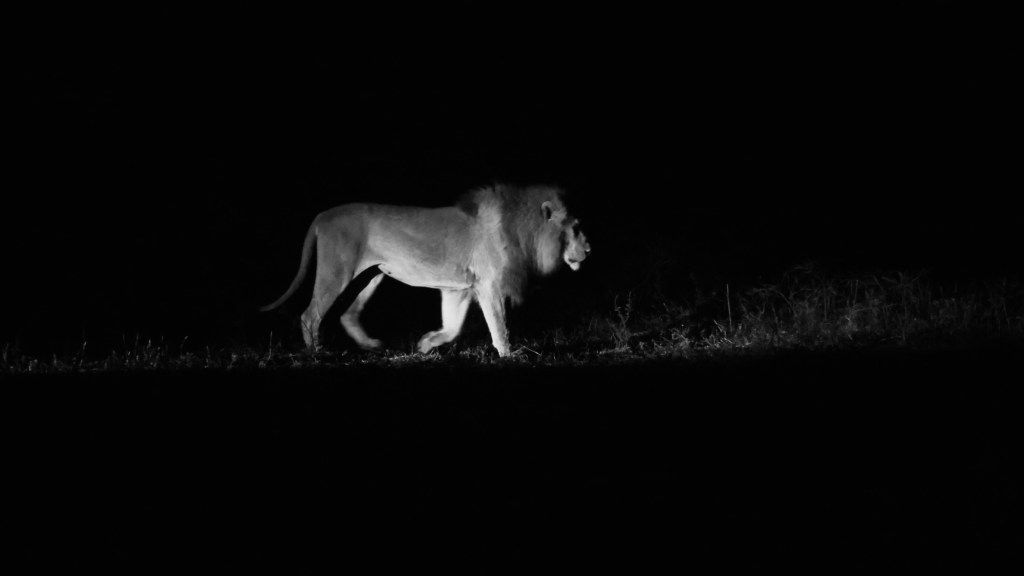
When I sent this picture (which I took this evening on my way home) to a friend, he responded with ‘this is Photoshop, isn’t it’.
Well, the answer is that it is not! Our dominant male lion raised his head from sleeping just as the sun had set. I was in the right place at the right time!
This picture was taken with my iPhone 14 Pro Max and was edited with the standard iPhone tools.
Here are the steps taken:
1 – The picture was first cropped to 9:16 (portrait).
Terrapins are the ultimate sun worshippers. On a nice warm day, they will pile up on top of one another to catch the sun’s rays and at the same time exchange body heat (retain as much heat as possible to stay warm).
A few days ago, I took this picture of nine of these ‘freshwater turtles’ on a piece of wood in the middle of one of Thanda Safari’s waterholes.
Technical data: Canon R6 with RF lens f/11 800mm | ISO 4000 | 1/500 sec | EV -1 | WB 6500K | AV Mode | Cropped to 10% of the original image.
One of the most iconic birds representing Africa is the African Fish Eagle. This large and beautiful bird of prey has a very distinctive call to communicate with other members of its species.
They resemble the American Bald Eagle as they are part of the same bird family (Accipitridae).
The African Fish Eagle is typically larger in size compared to the Bald Eagle. The African Fish Eagle has a wingspan of up to 8 feet (2.4 meters) and a body length of around 3 feet (0.9 meters). In comparison, the Bald Eagle has a wingspan of around 6.5 to 7.5 feet (2 to 2.3 meters) and a body length of about 2.5 to 3 feet (0.76 to 0.91 meters).
I took this picture of an African Fish Eagle landing on a tree stump at the Falcon Ridge Bird of Prey Centre in the Drakensberg. A place well worth visiting!
Technical data: Canon R6 with RF lens f4-6.3/24-240mm | ISO 800 | 1/2000sec | f4.5 | ev+2 | 62mm | WB 6500K | AV Mode | Crop to 60% of original image
Today, I am departing for a brief excursion into the Drakensberg Mountains. I plan to explore some new locations and attend two concerts featuring the renowned Drakensberg Boys Choir.
Before my departure, I thought I share a short slide show with some of my favorite photographs captured at Thanda and Pakamisa over the past three weeks.
I hope you will like the combination of wildlife, scenery, and night skies.
If you want to read more of my stories and see more of my pictures, you should visit my blog at https://sperka.info/blog/