[View all Pictures of the Week 2012]

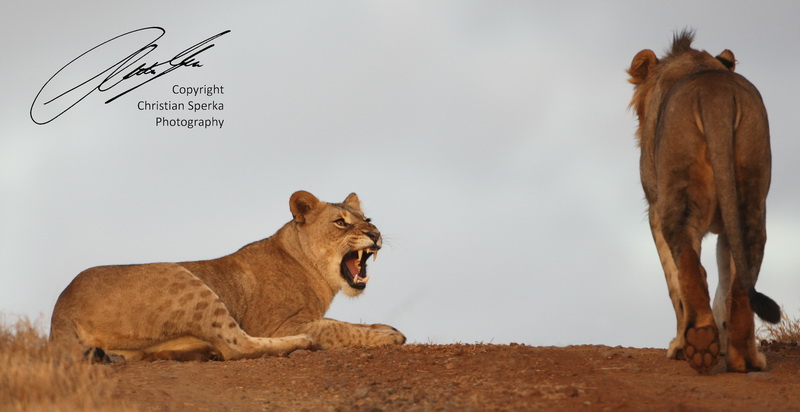
Most of the time you see a picture of a lion with an open mouth the animal is either yawning or flehming. It may look threatening and intimidating but it really is neither.
The young lioness in this pictures shows that she is quite upset. She is growling at two young males (one of them in the picture), which were part of a different pride, who walked quietly past her in a show of dominance.
This scene was part of an encounter of the juvenile offspring from two prides on Thanda Private Game Reserve (2 males and one female on both sides). This happened while the adult females of each pride were absent.
During the time we watched the encounter there were no open hostilities, just lots of territorial marking behavior, many growls and fierce facial expressions (as the one in the picture 🙂
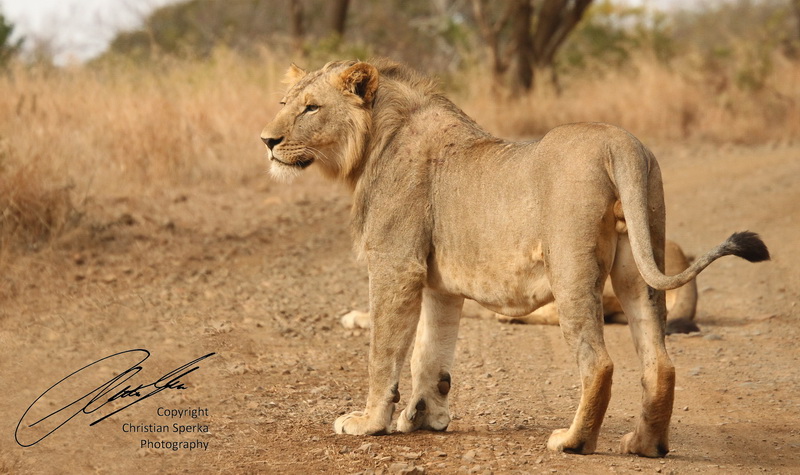
But the next day the males of both prides showed obvious signs of a night battle (wounds from claws on his shoulder – see the picture below).

More about lions:
Both males and females defend the pride and its territory against intruders. The male(s) associated with the pride must defend their relationship to the pride from outside males who attempt to take over their relationship with the pride. Females form the stable social unit in a pride and do not tolerate outside females. Membership only changes with the births and deaths of lionesses, although some females do leave and become nomadic and/or form a new pride. Sub-adult males on the other hand, must leave the pride when they reach maturity at around 2–3 years of age.
Picture Data:
Picture 1: Camera: Canon 1Ds MIII / Lens: Canon L 4.0 500mm / Mode: AV / Shutter Speed: 1/500s / Aperture: f/4 / ISO: 400 / Exposure Correction +1eV / Metering: Central weighted / White balance: manual K6500 / Time: midday / Freehand
Picture 2: Camera: Canon 1D MIV / Lens: Canon L 3.5-5.6 28-300mm at 210mm / Mode: AV / Shutter Speed: 1/4000s / Aperture: f/5.6 / ISO: 1600 / Exposure Correction +0.5eV / Metering: Central weighted / White balance: manual K6500 / Time: mid morning / Freehand
For more Lion pictures got to
www.sperka.biz/lion (for African Lion)
www.sperka.biz/lion2 (for African Lion in zoos)
www.sperka.biz/lion3 (for Asiatic Lion)