Christian Sperka is a wildlife photographer based at Thanda Private Game Reserve, Kwazulu Natal, South Africa.
Over the last 11 years, Christian has traveled the world photographing animals in wild game reserves of South Africa and Namibia, the jungles of Costa Rica, in Yellowstone National Park in the USA, as well as zoos in Europe and the United States. His work has been featured in wildlife magazines, in books and in many zoo publications.
He actively supports wild cat conservation, working as a partner photographer for Panthera, the world's leading organization devoted to the conservation of all wild cat species (panthera.org).
From 2009 to 2012 he has worked as the official photographer and photography teacher at Nashville Zoo at Grassmere, Tennessee, USA (nashvillezoo.org).
Christian is also a qualified South African field guide. He now works as specialist photography guide on Thanda Private Game Reserve in Kwazulu Natal, South Africa (thanda.com).
My brother Stefan visited me in November last year at Thanda. And he has taken quite a few shots of me during his stay. This is a collage with some his images – featuring me at work. Thanks Stefan!
Click on the image to enlarge.
From top left to bottom right – me …
…in my car in front of the Oysterbox hotel
…sitting in the Thanda Safari Lodge lounge
…with Dulcie at the Thanda Safari Lodge
…standing behind the outside dining table at Thanda’s Villa iZulu
…with Rachel and Jabulani at the Elephant interaction
…with Stefan, Bheki and my Land Rover
…talking to a family during a local community visit
…visiting a zulu homestead
…driving my “Landi”
…setting up the bar on my landrover for an evening drink stop
…in my office
…in front of my room
…with a White Rhino on game drive
The WordPress.com stats helper monkeys prepared a 2013 annual report for this blog.
Here’s an excerpt:
The concert hall at the Sydney Opera House holds 2,700 people. This blog was viewed about 29,000 times in 2013. If it were a concert at Sydney Opera House, it would take about 11 sold-out performances for that many people to see it.
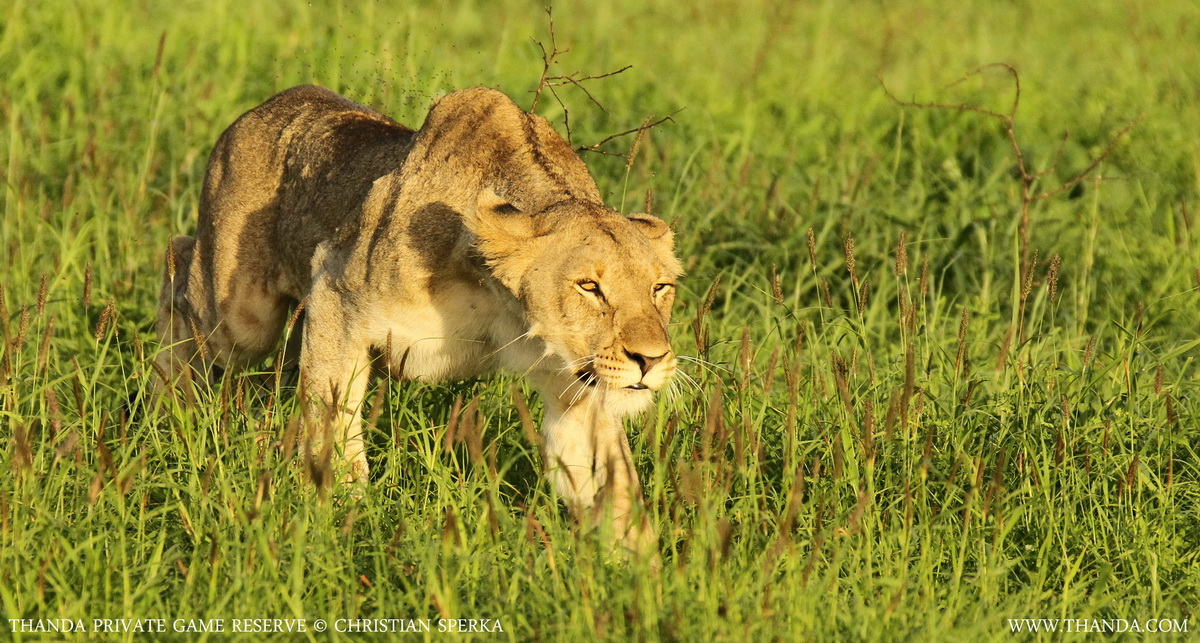
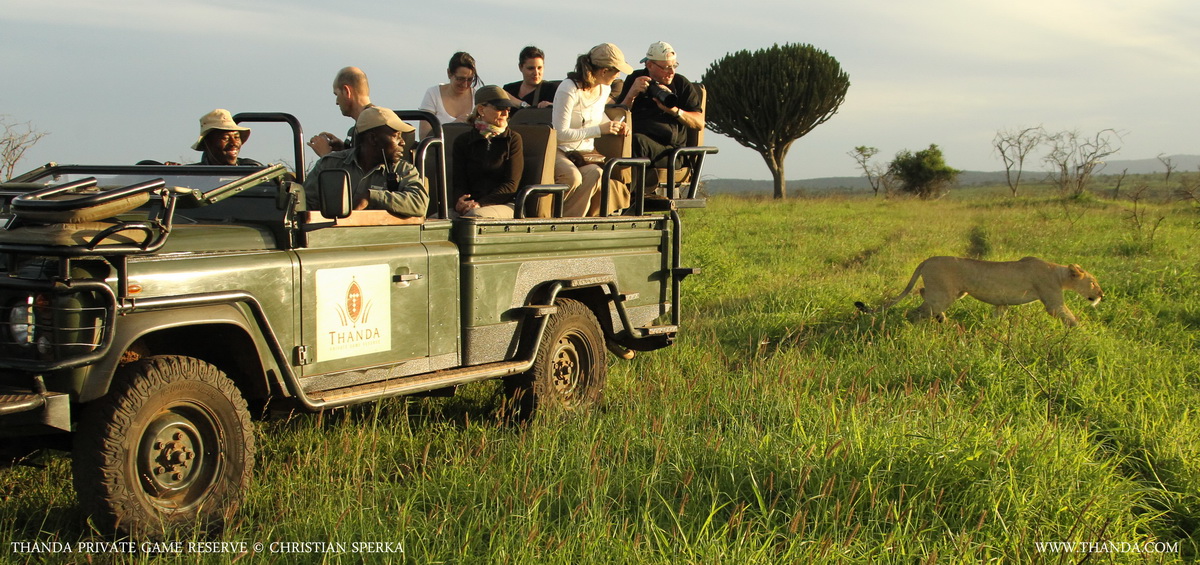
This young Lioness was stalking prey – using one of the game viewing vehicles as cover. An exciting and unforgettable moment for the Thanda guests on the Land Rover!
During my December visit at Pakamisa Game Reserve the weather did not cooperate and I was not able to go for a horse ride. But this time everything worked well and I was able to ride a horse for the first time in my life.
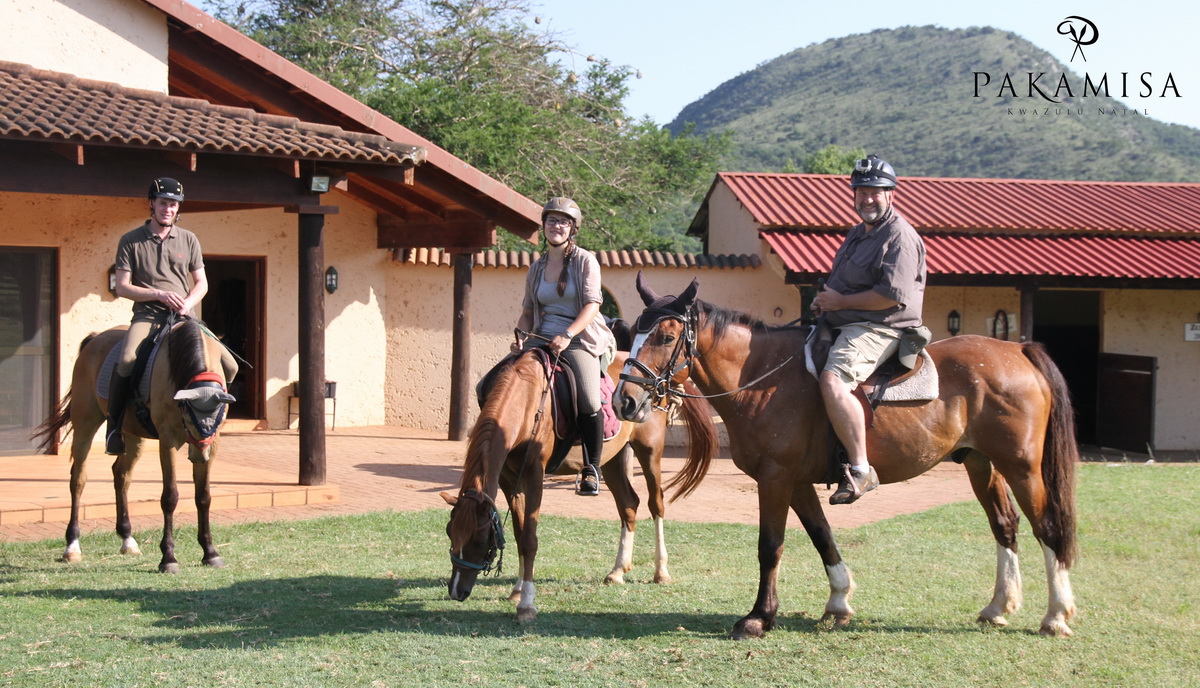
Yesterday and today “two portly gentlemen”, Badger – a sturdy Shire Horse – and I, went for two rides around Pakamisa. I enjoyed it very much, even if my “back side” still has to get used to the process 🙂
Two of Pakamisa’s horse trails guides, Fabio on El Dorado (a Boerperd) and Alexandra on Bolina (a Pure Arab Mare) were instructing me well on my first horse-riding attempt. I certainly will be back for more safaris on horseback.
I am spending four days of my work-off-time at Pakamisa. I get a bit of rest at this beautiful spot in the Zulu hills, enjoying the excellent food, sub-merging myself in a cool pool in the hot weather and getting close to wildlife on horseback. What a life!
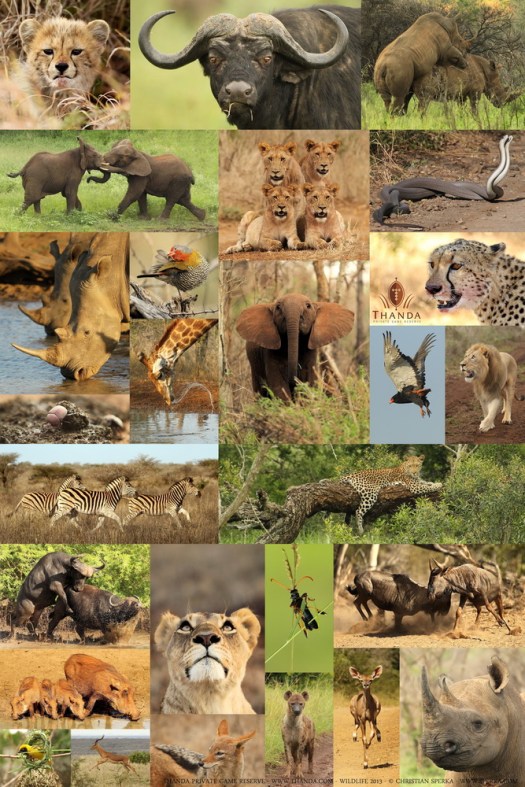
I have created a new collage of some of my favorite wildlife images I took at Thanda Private Game Reserve. All images were taken during my 390 game drives in 2013.
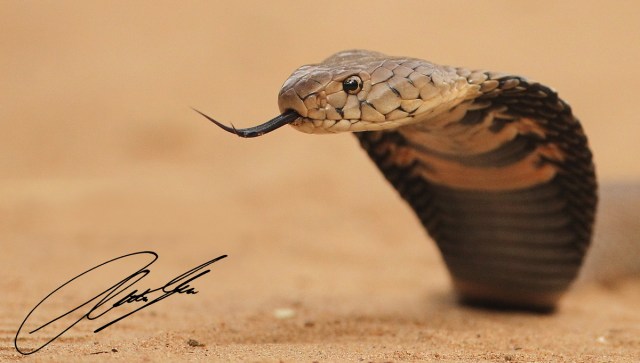
This morning I had to “rescue” a Mozambique Spitting Cobra. This snake had lost her way into one of Thanda store rooms. Someone spotted it disappearing behind a cabinet in the room.
Lodge management called me to capture the snake and to remove it to a new home. First I had to empty out the cabinet (hundreds of cans and bottles :-)) to be able to move it and to get to the snake hidden behind.
Once the cabinet was out of the way the Cobra did, what Cobras do. It opened it’s hood and made hizzing sounds to scare me away. I used a “snake grabbing stick” to capture it (20 cm behind the head) and carried it out of the room holding it also by its tail.
Once safely lodged in a special snake barrel I drove the snake to one of Thanda’s waterholes. Thanks to Jarred Glasson, Thanda’s Head Guide, I have some images of me releasing the snake at its new home!
More about Mozambique Spitting Cobra (Naja mossambica)…
It is native to Africa. The average length of adults is between 90cm – 105cm (3-3½ feet). This species prefers localities near water, to which it will readily take when disturbed. It is considered one of the most dangerous snakes in Africa. It can spit its venom. Its bite causes severe local tissue destruction. Venom to the eyes can also cause impaired vision or blindness. This cobra’s diet mainly consists of amphibians, other snakes, birds, eggs, small mammals, and even insects occasionally. This snake is nervous and highly strung. When confronted at close quarters it can rear up to as much as two-thirds of its length, spread its long narrow hood and will readily “spit” in defense, usually from a reared-up position. By doing this the venom can be ejected at a distance of 2-3 metres (6½-10 feet), with remarkable accuracy. The spitting cobra does bite depending on its environment and the situation it is in, and also feigns death to avoid further molestation.
My guests enjoyed this very special sighting of a small insect. Skillfully light by Bheki’s spotlight I took this shot of a Katydid. To get a shot on eye level I had to stretch out on the ground. This picture is a prime example why “wildlife-eye-level-photography” is so important.
Picture by Christian Sperka – Specialist Photography Guide and Resident Wildlife Photographer – Thanda Private Game Reserve.
More about …
Insects in the family Tettigoniidae are commonly called katydids or bush-crickets. There are more than 6,400 species. They are also known as long-horned grasshoppers, although they are more closely related to crickets than to any type of grasshopper. Many tettigoniids exhibit mimicry and camouflage, commonly with shapes and colors similar to leaves.
We had some great sightings this morning – First a herd of Buffalo enjoying themselves at a Waterhole, then four Lions trying to hunt some Buffalo and finally three White Rhino enjoying the sun after a mud bath. The guests on my vehicle were especially impressed with the Lion-Buffalo interaction. It was not always clear who was the hunter, and who the hunted? The Lions gave up at the end and the Buffalo moved on.
At one time we could see all three “Big Five” species from one spot : looking to the left > the Lions / looking straight on > the Buffalo / looking to the right > the Rhinos. The three landscape images below were taken without moving the vehicle!
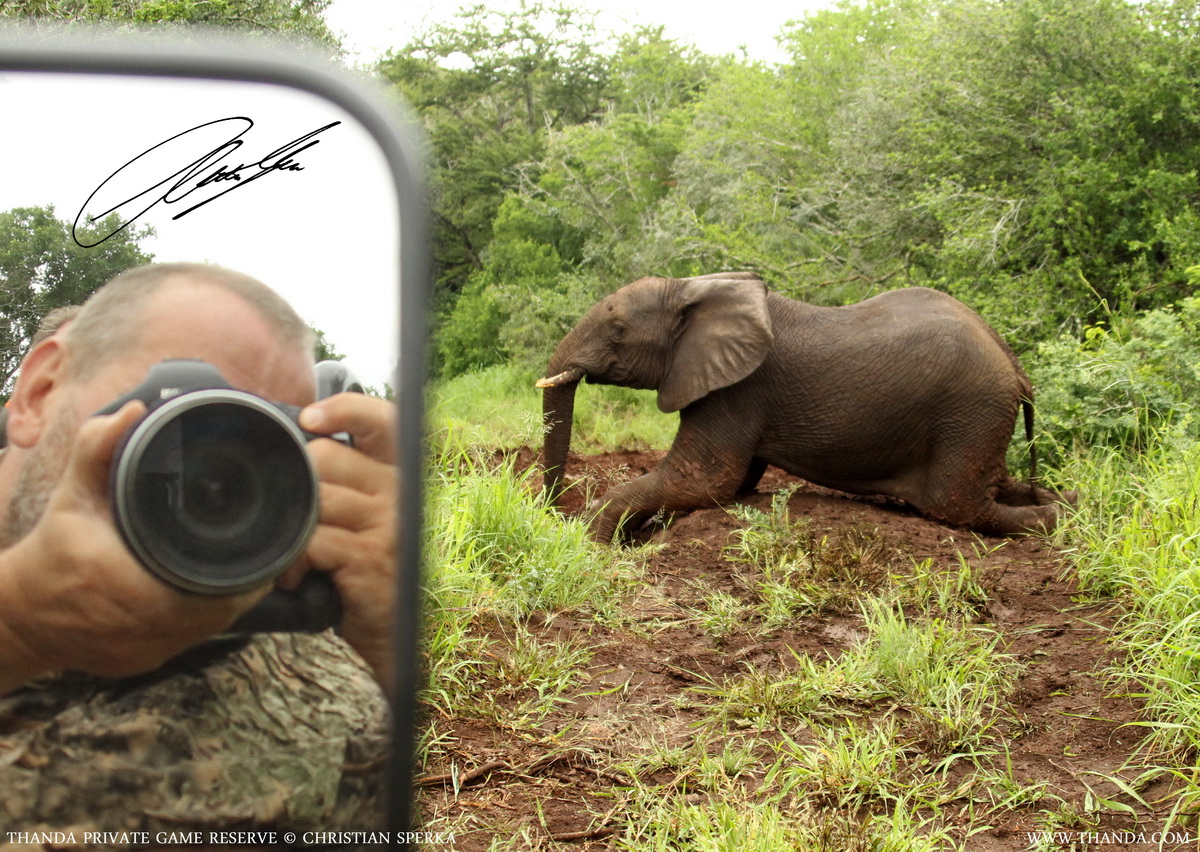
This image, taken on one of my recent game drives with Thanda guests, shows clearly that Elephants have elbows on their front legs and knees on their back legs – just like us 🙂
On the same drive one of our large Elephant bulls appeared just next to us out of the bush. An exciting moment for the guests, not used to the sudden appearance of 6 ton animals. The bull calmly waited for us to get of the road so he could continue to strive in his planned direction – following the herd.
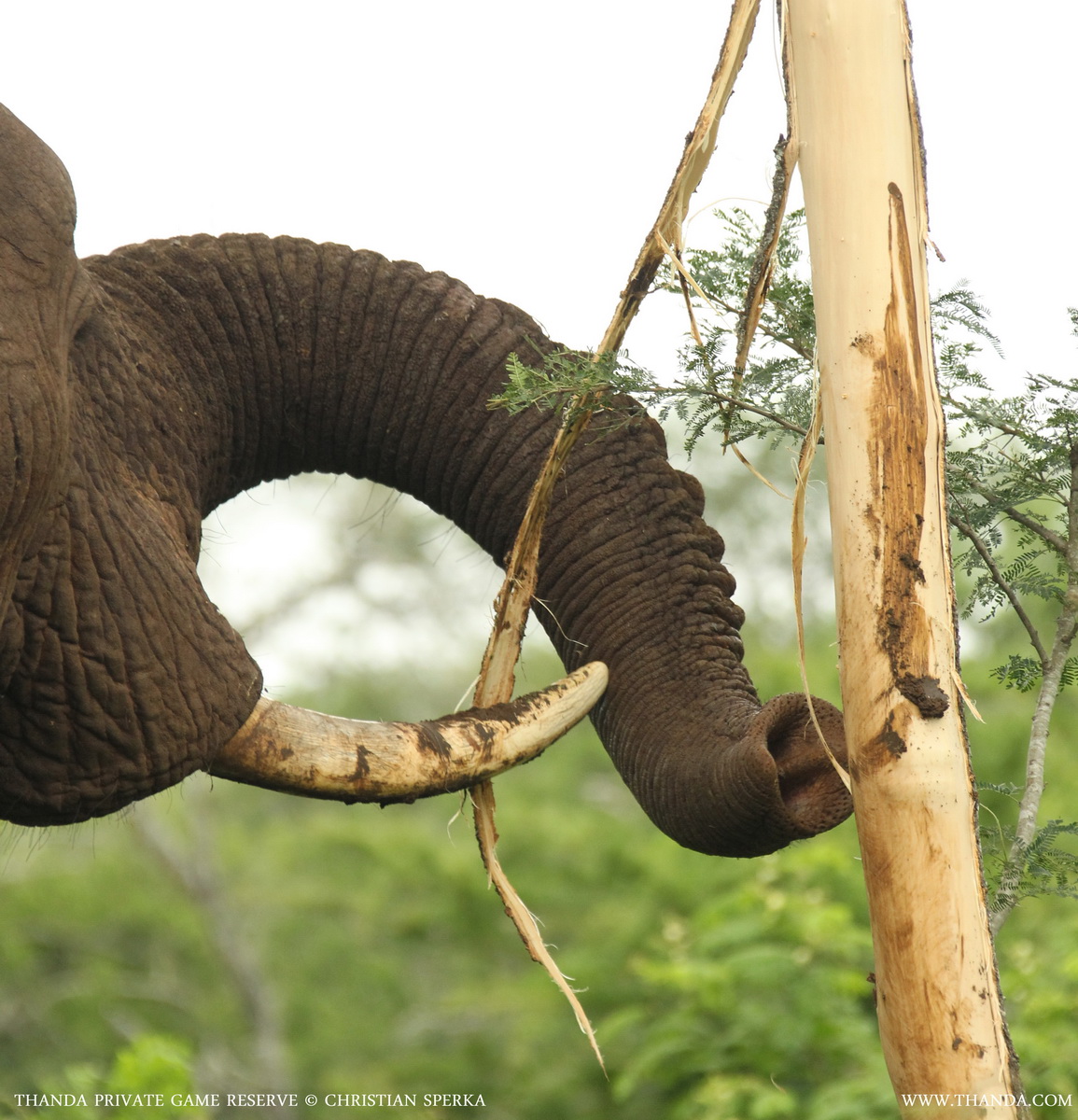
And one of the younger bulls demonstrated his ability to strip the nutrient-rich layer from underneath a tree’s bark, using his tusks and his trunk.
What a great Elephant sighting!
Pictures by Christian Sperka – Specialist Photography Guide and Resident Wildlife Photographer – Thanda Private Game Reserve.






 Christian Sperka Photography | Custom Luxury Tours