
Our dominate male Lion was greeting us at the start of our morning game drive. He had rested on top of a hill for the night.

Our dominate male Lion was greeting us at the start of our morning game drive. He had rested on top of a hill for the night.

Quite a few people have asked what photography teaching services I offer at Thanda – here is the information:
As a guest at Thanda Private Game Reserve you may request a complementary 90 minute photography session (based on availability/between game drives). In these sessions you will learn how to set up your camera for wildlife photography, what do adjust during shooting on game drive (motto:keep it simple) and I will show you what makes a good wildlife image. It does not matter if you stay at the Lodge, the Tented Camp or the Private Villa.
At time of booking you stay at Thanda you can also request me as your field guide during your stay to spend additional photography time with me in the bush.
I am looking forward to seeing you at Thanda – Christian Sperka
Contact reservations@thanda.co.za for more details and rates…

In case you would like to know a bit more about my Motion Photography Method go to https://christiansperka.wordpress.com/motion-photography-rules/

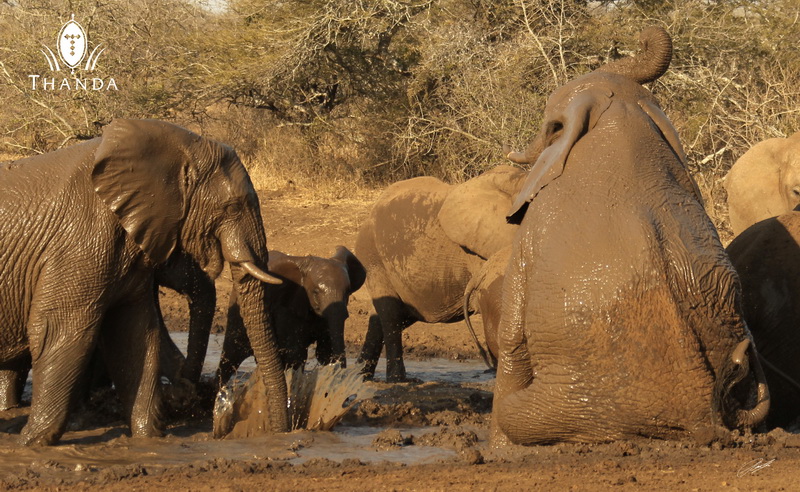
Most mammals can use their sweat glands to cool themselves down. Elephants cannot sweat so they have to use other means to cool down. They pump huge amounts of blood through their ears (which represent 20% of their body surface) while waving the ears – as one means of cooling. They also try to use shade wherever possible and take extended baths on hot days. But one of the most effective ways of lowering their body temperature is to take a mud bath. The drying mud draws a lot of heat from the body and cools them down very effectively.
On yesterday’s evening game drive I took this picture of one of the largest Thanda bulls after he had a thorough mud bath.

The second picture is of a “family bath” a few month ago.
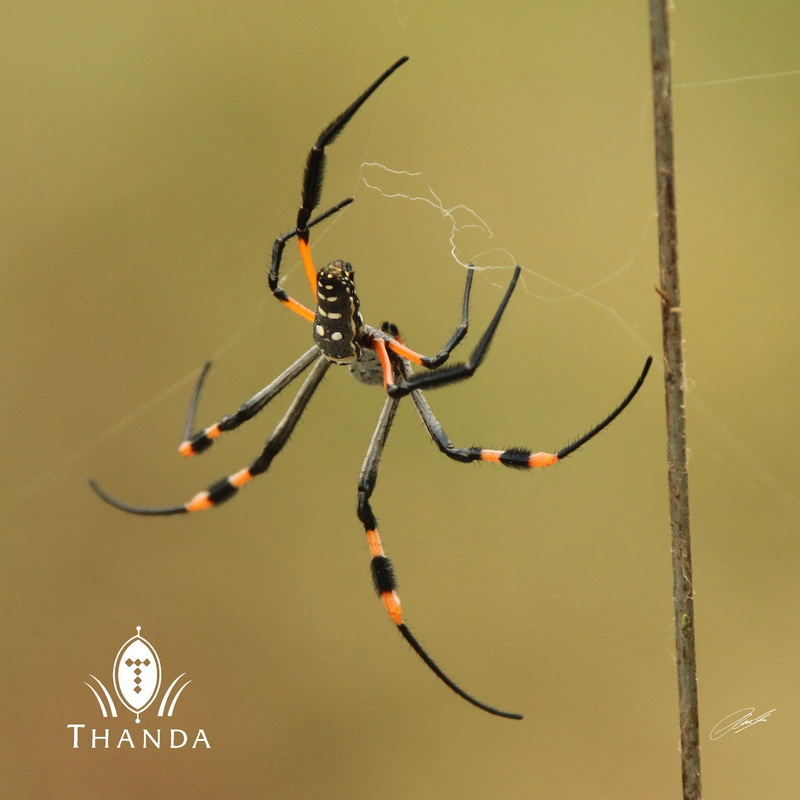
When the weather gets hot and humid many different species of Golden Orb Spiders build their webs along and across the roads on Thanda. Part of Bheki’s job at this time of the year is to take down the webs across the roads before they reach our guests.
It is good to know that spiders do not like large warm-blooded mammals and therefore avoid any contact with humans. Even in the rare case that one touches Bheki’s fingers it immediately descends and gets away from him. That also means that one can walk or drive safely beneath their webs – they do not drop on people 🙂
These beautiful creature occur in many color variations.
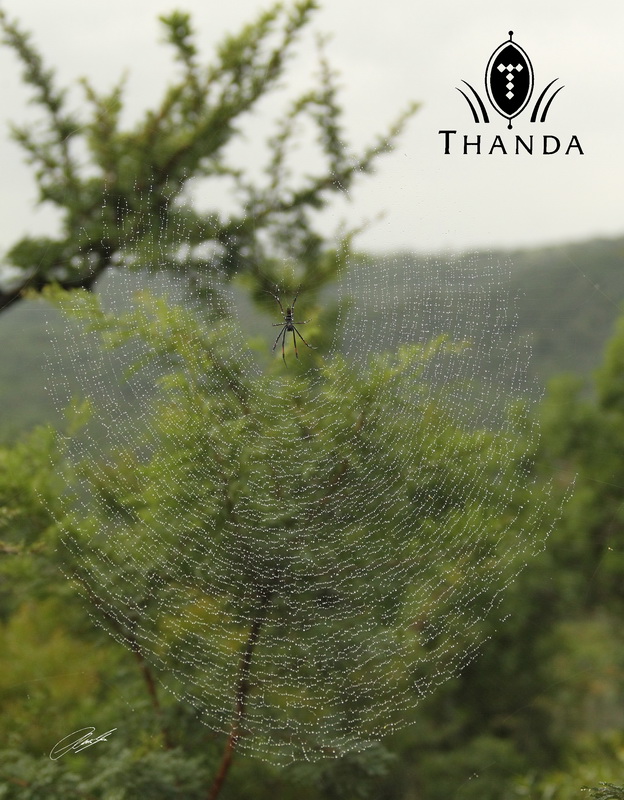
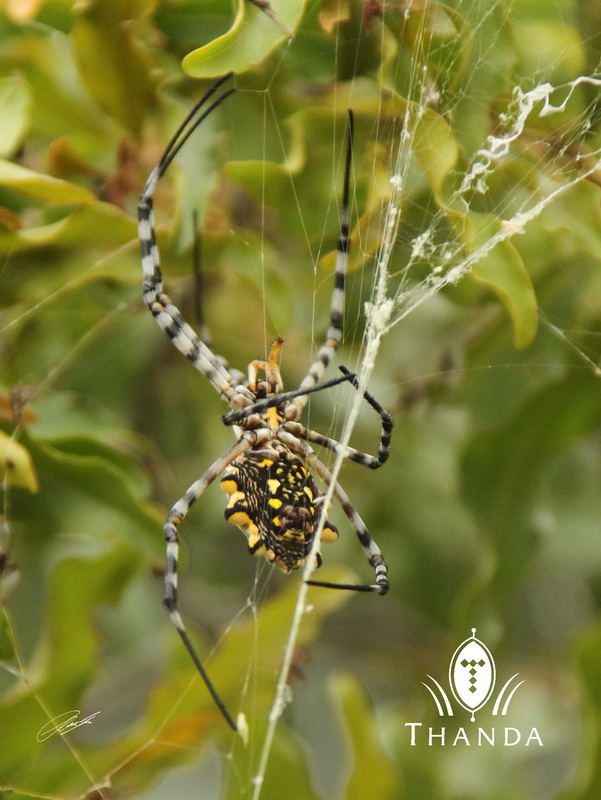
More about Golden Orb Spiders:
The Golden Orb Spiders (genus Nephila) are a genus of spiders noted for the impressive webs they weave. Nephila consists of numerous individual species found around the world. They are also commonly called Golden Silk Orb-weavers, Giant Wood Spiders, or Banana Spiders.
Golden Orb Spiders usually reach sizes up to 5.1 cm (2 in) in females, not including leg span, with males being usually 2/3 smaller (less than 2.5 cm, 1 in).
They are the oldest surviving genus of spiders, with a fossilized specimen known from 165 million years ago.
These spiders do not seem to form either beneficial or harmful relationships with humans. An (unlikely) bite causes local pain, redness, and blisters that normally disappear within 24-hours.

These Vultures were hoping that the Lions would move away from their nearby kill soon. This picture was taken in the early hours of the day before it started heating up.
All images are of White-backed Vultures, the most common vulture species to be seen on Thanda.

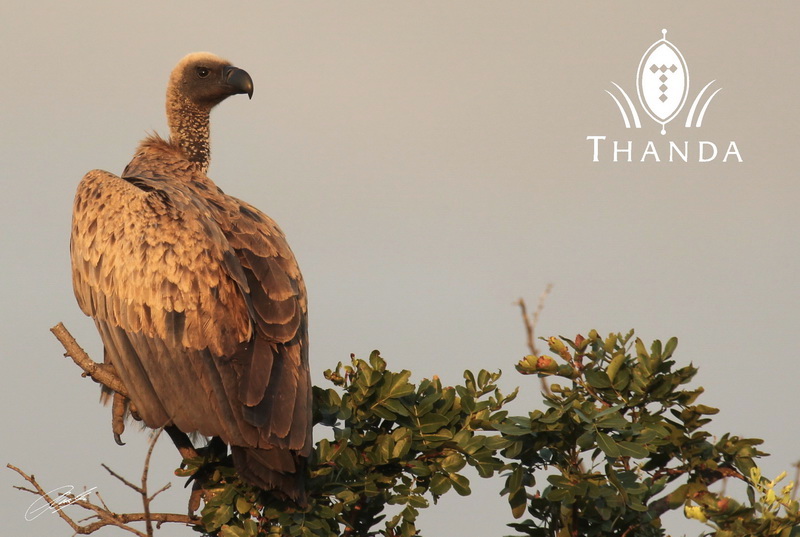 About White-backed Vultures:
The White-backed Vulture is a typical vulture, with only down feathers on the head and neck, very broad wings and short tail feathers. The adult’s whitish back contrasts with the otherwise dark plumage. This is a medium-sized Vulture with a wingspan up to 2.25 m (7 ft).
Like other Vultures it is a scavenger, feeding mostly from carcasses of animals which it finds by soaring high over the savanna. It often moves in flocks. It breeds in trees , laying one egg. The population is mostly resident. Its conservation status is “Endangered”.

I do not often merge or manipulate images, but I had to play with this picture of Bheki – my Tracker – looking into a sunrise. I merged it with an image of our dominate male Lion.
We were looking for Lions at the time, so I created this collage in memory of that morning 🙂
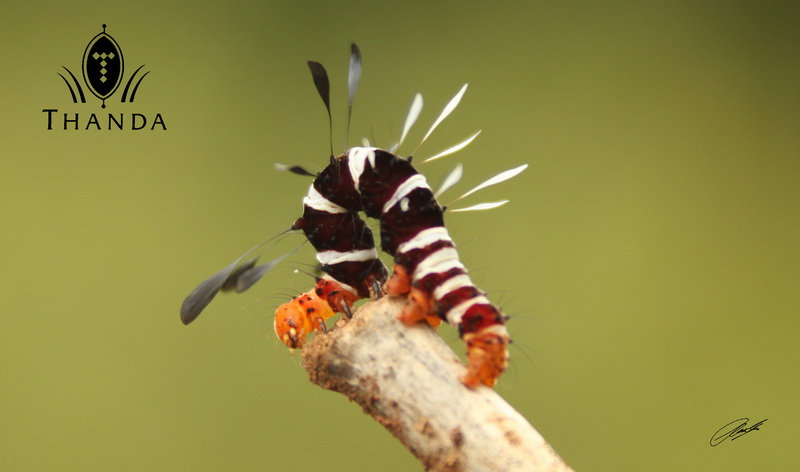
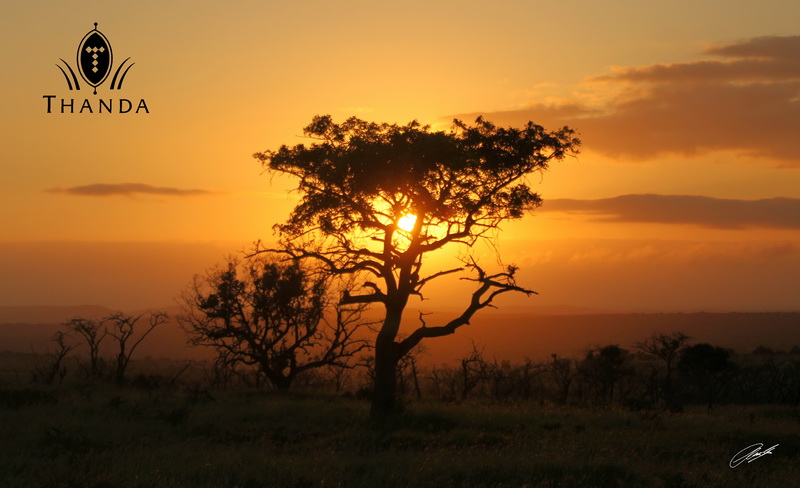
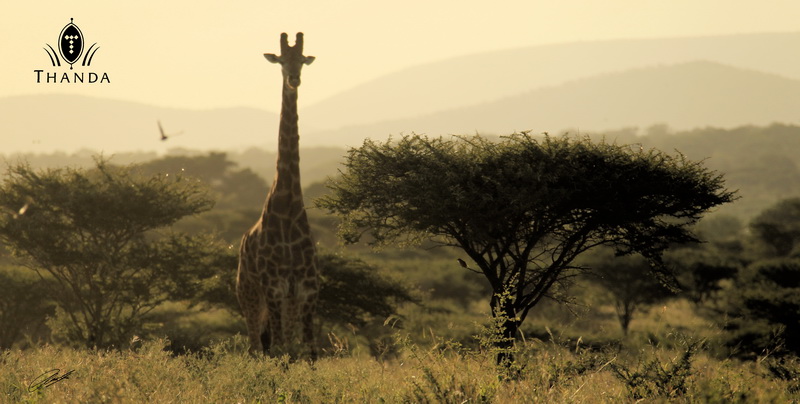
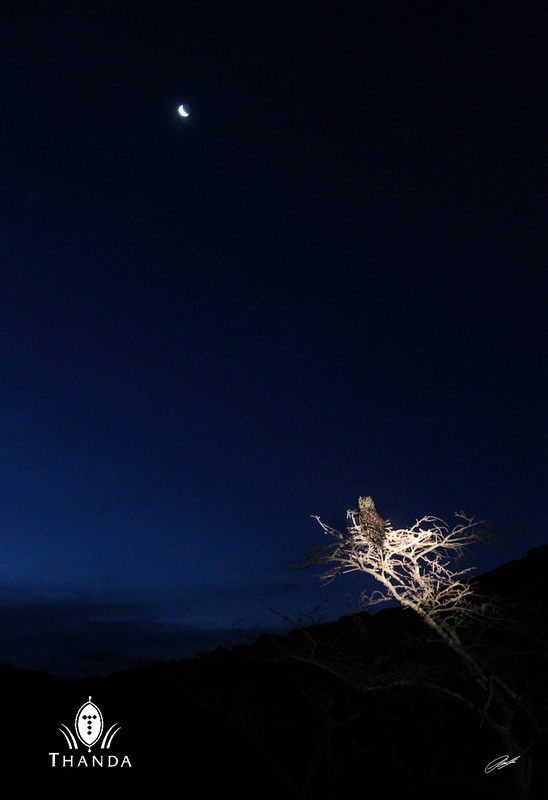
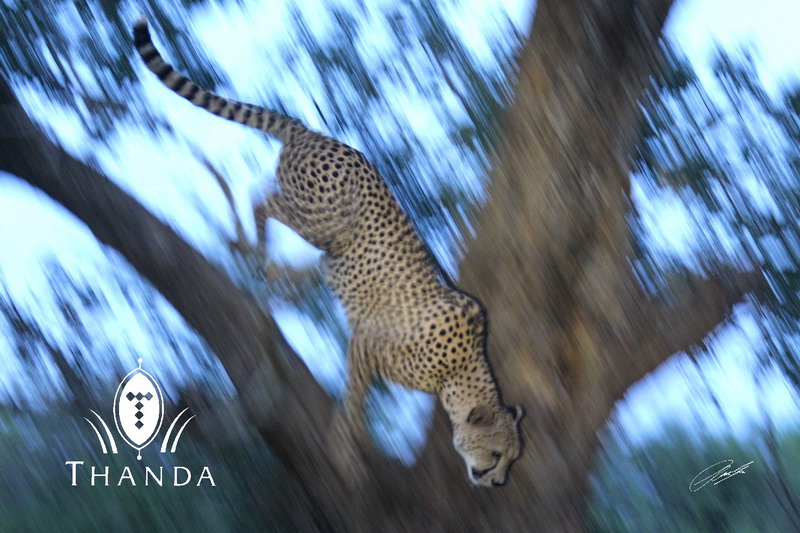
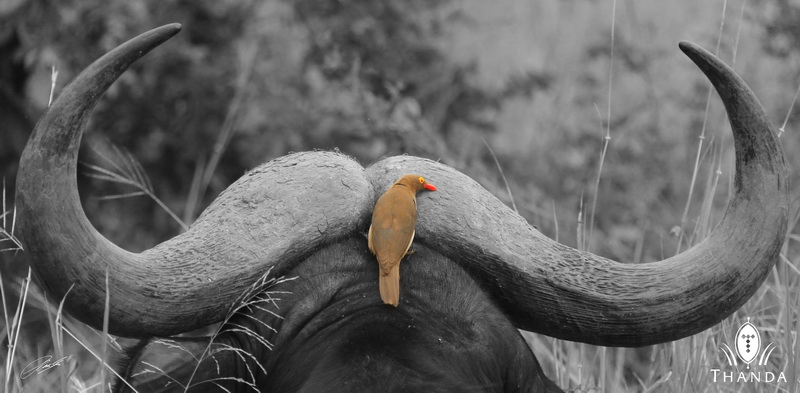
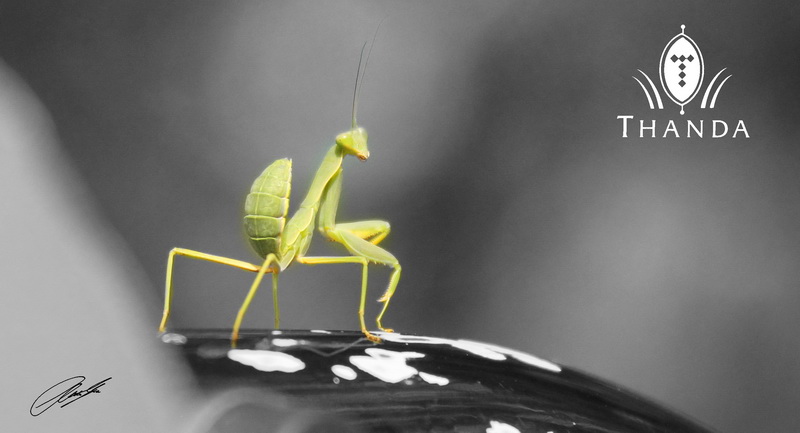
These are seven images I took during the holiday season – when my Internet connection was down. They are part of my “Without the Five” series (images 5-11).
– A colorful Caterpillar (I have no idea what species this is)
– A Thanda summer sunrise
– A morning bush scene with Giraffe and Buzzard
– A Spotted Eagle Owl in the moon/spot light (this image is a “merge” of two pictures from the same scene)
– A male Cheetah in motion
– A Red-billed Oxpecker resting on a Buffalo horn
– A Praying Mantis sitting on my car
Enjoy these beautiful images from my African home!
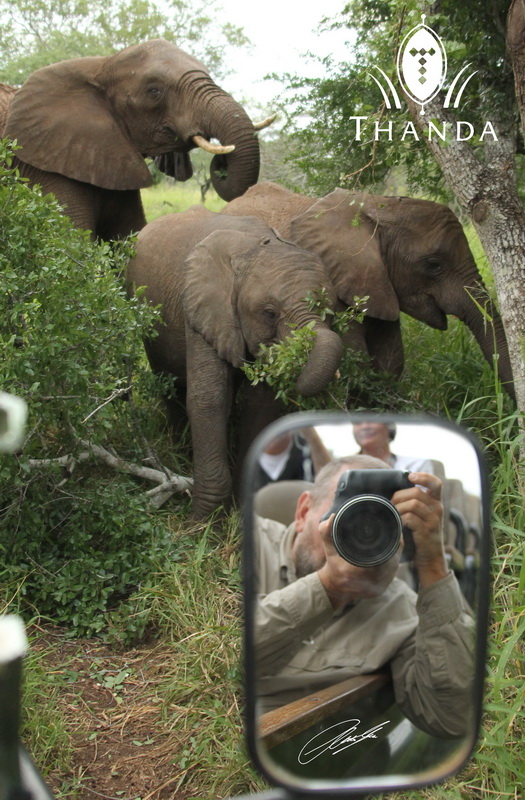
One should never push Elephants and move in too close to them.
But sometimes they choose to come close themselves. This female Elephant and the two calves where browsing on trees right next to our Land Rover before moving on to follow the herd.
My guests loved this close encounter!
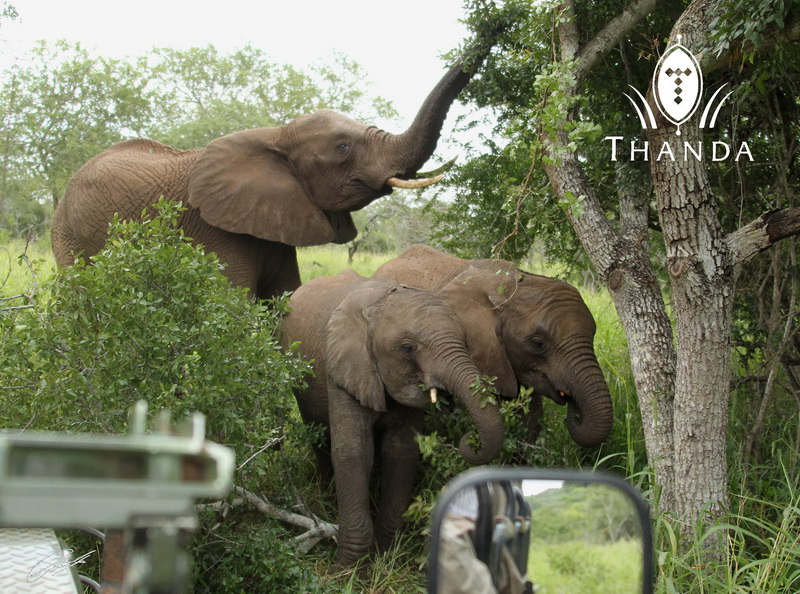
PS: For the photographers among you: To get the effect with both “the Elephants” and “me in the mirror” in focus I overlaid two images with different focus (post-processing).
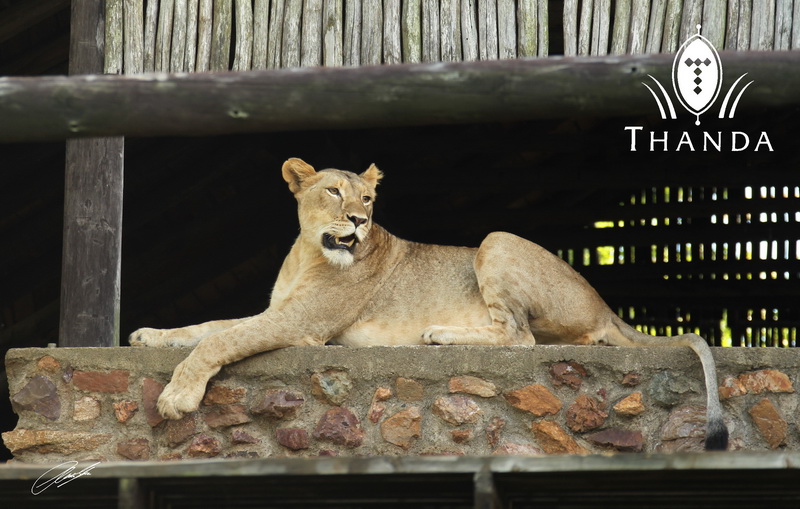
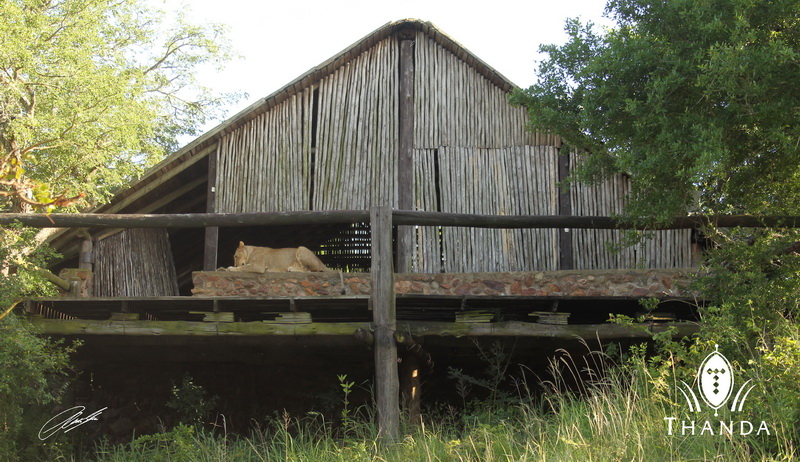
On Thanda we have an old bush school (a few A-frame huts and an old wooden classroom building) which is left from the days when Thanda was farmland.
On hot days the Thanda North Pride likes to use the classroom as shelter from the sun. Here are a few images from our Lions in school.
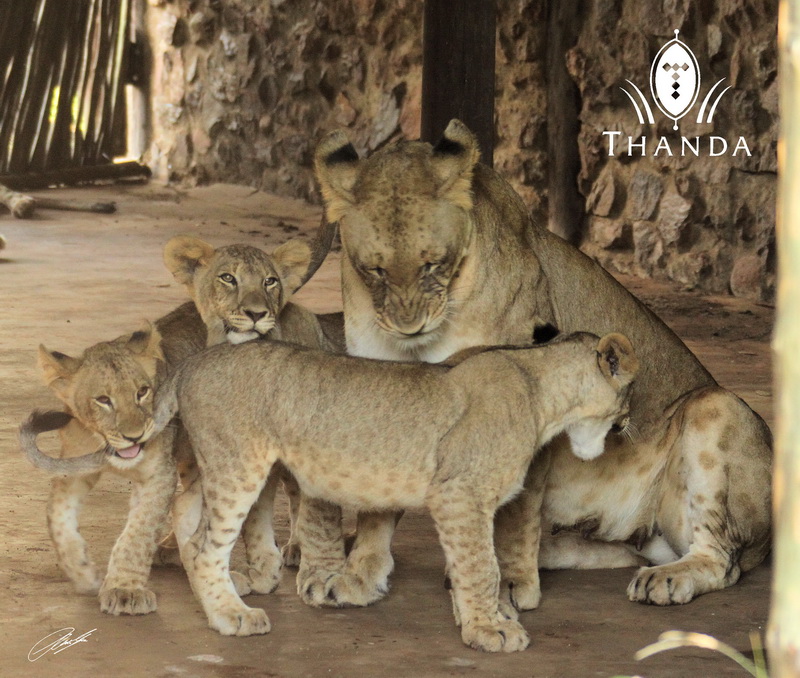
The little ones (about 8 month old now) learn from mom that is time to stop suckling. They complained noisily.
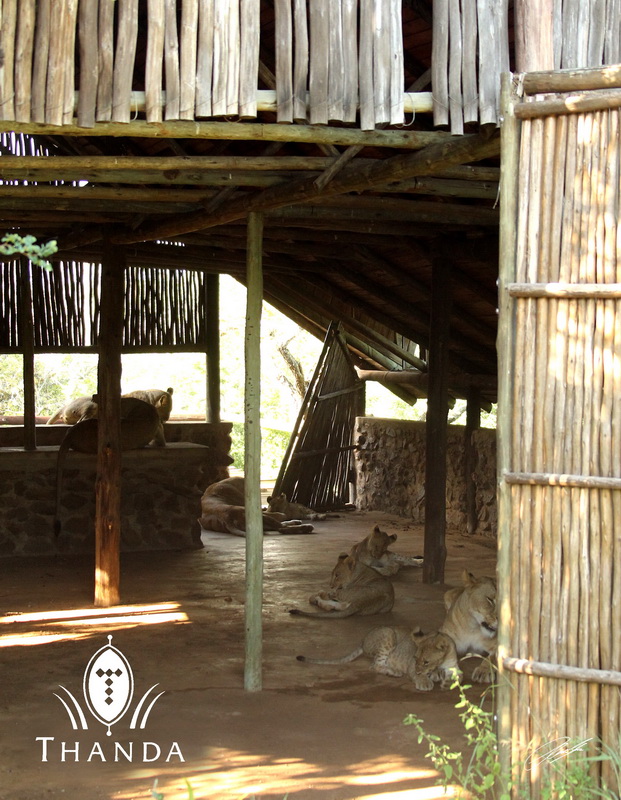
The shaded cool concrete makes for an ideal resting surface. Especially the concrete table (on the left) is popular when is gets very hot.
So if one is on a walk, one needs to be careful to look for shelter at the school – the Lions may already be there 🙂
Have a good week!
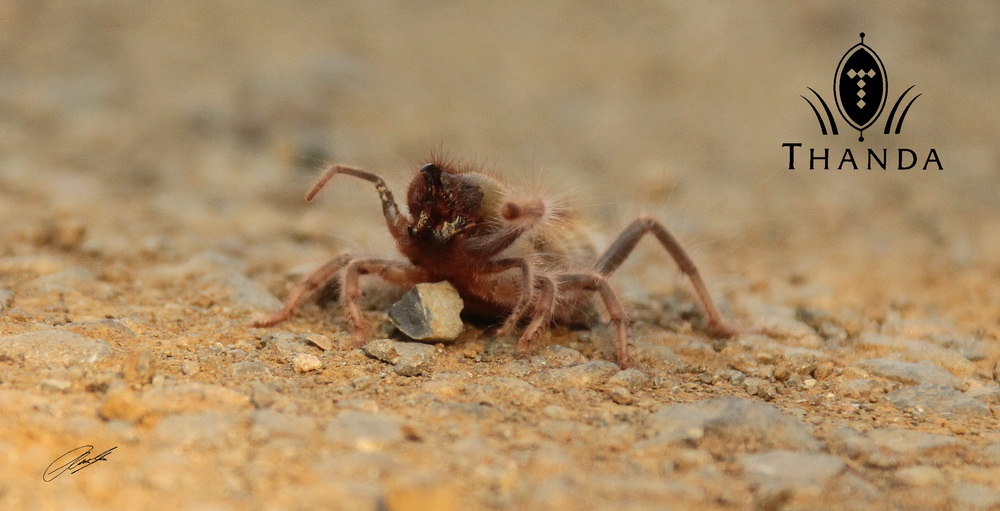
This sun spider sat in the middle of the road when I left the lodge. I took an eye level shot of this small predator – lying on my belly as usual 🙂
About Sun Spiders:
Solifugae are known variously as Camel Spiders, Wind Scorpions or Sun Spiders. The order includes more than 1,000 described species. Sun Spiders are a different order from the true Spiders and the Scorpions. Much like a spider, the body of a Sun Spider has two tagmata (body segments).
Unlike Scorpions, Sun Spiders do not have a third body segment that forms a “tail”. Most species of Solifugae live in deserts and feed opportunistically on small ground-dwelling animals. A number of urban legends exaggerate the size and speed of Sun Spiders, and their potential danger to humans, which is practically nil.
This image is part of my “Without the Five” series:
Each image features a species, which is usually not in the safari limelight. So they will be no images of Lions, Leopard, Elephants, Rhinos, Buffalo, Cheetahs …
Enjoy the “without the Five” series
 Christian Sperka Photography | Custom Luxury Tours