Silent Night!


What a night!

After I finished my evening game drive and after a quick meal at Intebane camp I was ready to go home. It was a dark, warm night with many stars overhead.

Just when I left the camp I heard a Lion’s roar nearby. Just a few hundred meters (yards 🙂 up the road a large male Lion walked towards me in the dark. Once he appeared in my headlights I switched them off, stopped the engine and watched him passing my vehicle just within a few meters (using my red-filtered spotlight).

I turned my car around and started following him. He made his way around the camp and moved to a dried-up waterhole in the valley below. On his way he stopped a few times to listen to the voices from the camp and to scent-mark along the road. He finally settled down in the middle of the waterhole. I switched off my car and my lights and I did let me eyes get used to the dark.

I stay with him for a while – looking at the stars in total silence – just a few meters away from one of the most magnificent creatures on earth.

That is why I love Africa!


Lion Chase!

Today we had a very interesting Lion sighting. The picture above suggests that this beautiful male Lion was chasing one of our Land Rovers.

He was not!

He was following three other male Lions on a neighbouring reserve up and down the fence. A lot of growling and snarling made for a very impressive “show” for our photography volunteers.

Enjoy the pictures!

Greetings after a day in the city!

When I returned this afternoon from Richards Bay, a city about 1.5 hours away from Thanda, a troop of Vervet Monkeys greeted me at Thanda House. One of them kept alarm-calling. He obviously did not trust me 🙂

A short while later a herd of Buffalo moved from East to West along the fence. When I got a bit closer to get some pictures they all focused on me for while and then lost interest and kept grasing and moving.

Tommorrow I will get my game viewing vehicle and I will start driving on the reserve learning the roads (and probably getting lost a few times in the process :-).

Good night!

Bush Office :-)

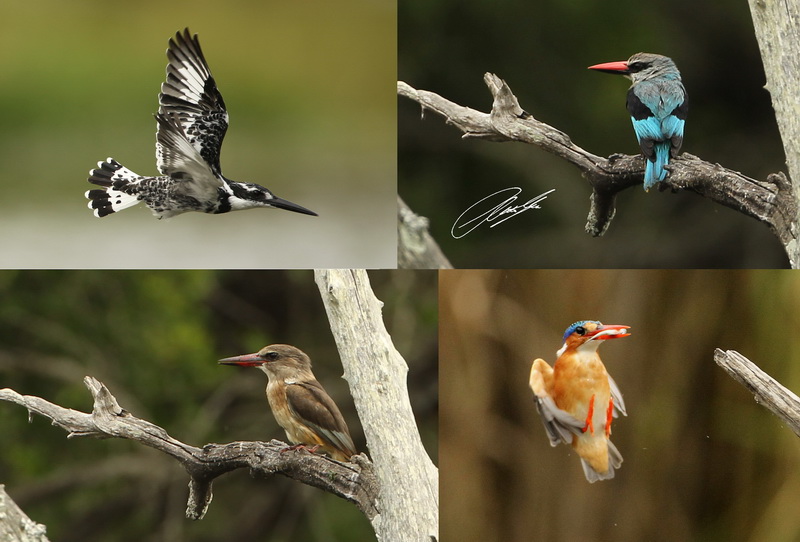
I took this picture of a Brown-hooded Kingfisher while I was sitting at the desk in my new “South African Bush Office”.

The room is quite spacious for all the computer and photography gear I brought with me and all my the stuff that will arrive by sea freight sometime in July.

Below are also pictures of the outside of Thanda House and of my office.

Picture of the Week 18 – Climb!

Small Cheetahs – as all other small cats – love to climb. Once they grow up it is much harder to get onto trees with their “semi-retractable” claws. These claws are designed like spikes to aid fast acceleration.

Nevertheless, in the picture below an adult male Cheetah climbed a low branch for a better look around in the morning mist.

Enjoy the pictures 🙂

For more Cheetah images go to http://www.sperka.biz/cheetah

Pictures of the Week 15 – Browse and Graze

[View all Pictures of the Week 2012]

Black Rhino and White Rhino

This weeks’ pictures are in honor of two of my favorite mammal species which are under the threat of extinction by humans. If the poaching madness is not stopped these creatures, which were on this planet long before us, will disappear forever!

The main difference between Black Rhino and White Rhinos is the shape of their mouths. White Rhinos have broad flat lips for grazing and Black Rhinos have long pointed lips for browsing foliage. A popular theory claims that the name White Rhinoceros was actually a corruption of the word weid (“wide” in Afrikaans), referring to their square lips.

“Rhino Dawn”

More about Rhinos:

Rhinoceros, often abbreviated as rhino, is a family of five species of knee-less, odd-toed ungulates. Two of these species are native to Africa and three to southern Asia.

The Rhinoceros family is characterized by its large size, with all of the species able to reach one tonne or more in weight; a herbivorous diet; a thick protective skin; relatively small brains for mammals this size; and a large horn.

Rhinoceros are killed by humans for their horns, which are bought and sold on the black market, and which are used by some cultures for ornamental or (pseudo-scientific) medicinal purposes. The horns are made of keratin, the same type of protein that makes up hair and fingernails.

Click here if you would like to help the “Save our Rhino” effort on Thanda Private Game Reserve.

Click here is you would like to know more about the “Rhino Poaching Issue”.

Click here if you would like to see more of my Black Rhino pictures.

Click here if you would like to see more of my White Rhino pictures.

Feathery Spectrum!

I have not posted a bird picture for quite a while. So here are a few images of one of my favorite birds in South Africa.

Lilac-breaster Rollers have many colors of the spectrum in their plumage.

These pictures were taken in Phinda Private Game Reserve, the Timbavati Private Game Reserve and in Kruger National Park.

More about Lilac-breasted Rollers:
The Lilac-breasted Roller (Coracias caudatus) is widely distributed in sub-Saharan Africa. Usually found alone or in pairs, it perches conspicuously at the tops of trees, poles or other high vantage points from where it can spot insects, lizards, scorpions, snails, small birds and rodents moving about at ground level. It is the national bird of Botswana.

Picture of the Week 14 – The tree that shines from afar

[View all Pictures of the Week 2012]

This African Elephant is browsing in between Fever Trees on Phinda Private Game Reserve, South Africa.

In the Zulu language the Fever Tree is called umHlosinga (the tree that shines from afar). This beautiful acacia has a pale white bark and green foliage. It is one of the few trees where photosynthesis takes place in the bark. The yellow color on the Elephant’s skin is from rubbing against one of the trees.

Enjoy the picture!

The Tree That Shines From Afar ( Fever Tree – Acacia xanthophloea)

More from Reelfoot Lake …

Here are four more Reelfoot Lake pictures (Tennessee, USA).

Check out Nancy Moore’s website for more information on boat trips on the lake http://blbweb.bluebasin.com (the site is about her “bed and breakfast” place, but she also does great photography lake trips – just contact her at jaybird@bluebasin.com)

Into the Sun – Osprey and Geese at Sunrise on Reelfoot Lake

Take-off – Duck on Reelfoot Lake

Nesting – Bald Eagle at Reelfoot Lake 

What are YOU looking at? – Osprey at Reelfoot Lake

Enjoy the pictures!