
Bheki – my tracker on Thanda – is an excellent birding guide. And he usually is able to identify any bird for our guest or for me :-).
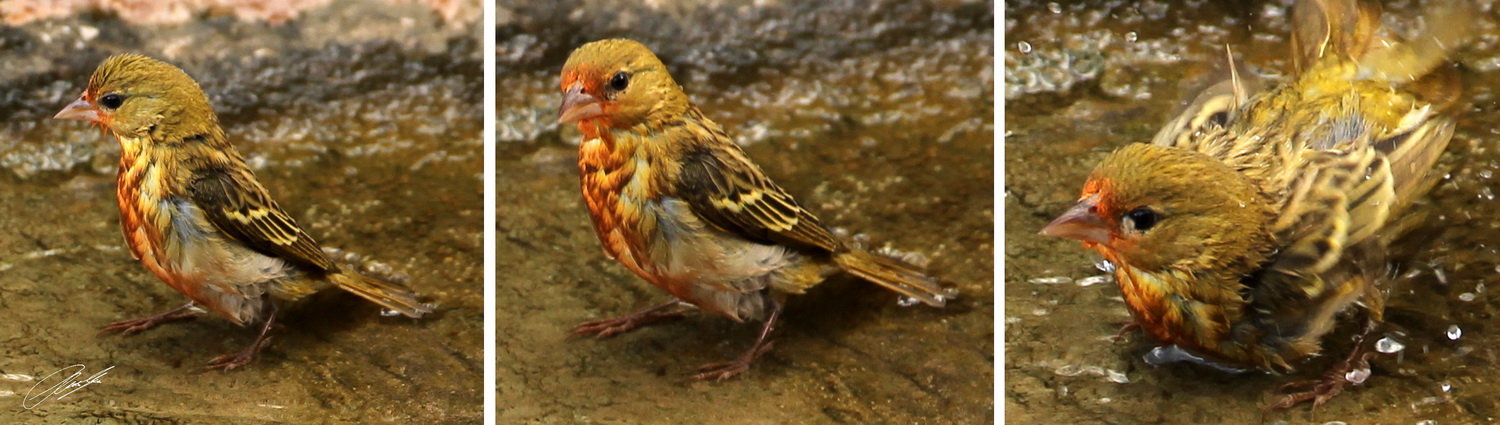
But this one puzzles us both. I shot this image in July 2011. As I am currently reviewing all my images – many thousands 😦 – I came across this one and wanted to get an ID.
Does anyone have an idea what this is (it looks like a Weaver or Canary with some of the colors of a Barbet).
Thanks for the help!
 Christian Sperka Photography | Custom Luxury Tours
Possibly a Cape Weaver
You were close!
We got the answer 🙂 It seems to be a Village Weaver female which had indulged herself in a Aloe pollen feast – hence the orange color. Thanks for your comment!
My guess it’s a weaver that has been aloe probing
Thanks Mike – I think you are correct. It was during Aloe blooming season. Looking at the wing pattern and at the location where I took the image I think it is a female Village Weaver.
Hi Christian.
Answer from a very reliable source in the birding community.
The orange colouration on face and breast can be ignored. This is as a result of pollen from flowers. The weaver has been feeding on nectar. My guess is non- breeding Southern Masked Weaver.
Sent from my iPhone
>
Thanks for your help, Daniel – That explanation makes sense. It was during the Aloe blooming season. Looking at the wing pattern and at the location where I took the image I think it is a female Village Weaver.
Just searching a little. Maybe see this link: http://pl.wikipedia.org/wiki/Potrzeszcz Sorry it is in Polish but there is a translate button. A Bunting (Portrzeszcz) Typically in North Africa but some do migrate to the South in Winter.
We got the answer 🙂 It seems to be a Village Weaver female which had indulged herself in a Aloe pollen feast – hence the orange color. Thanks for your comment!
A golden throat sperka.
Thanks Karen. Unfortunately there is no species named after me 🙂
But we got the answer 🙂 It seems to be a Village Weaver female which had indulged herself in a Aloe pollen feast – hence the orange color. Thanks for your comment!
Only familiar with N American birds but it is similar to our finch and warblers…but the beak is longer than a finch and wider than a warbler??? Good luck. Pretty little thing even if a bit muddy. Let us know if you figure it out.
We got the answer 🙂 It seems to be a Village Weaver female which had indulged herself in an Aloe pollen feast – hence the orange color. Thanks for your comment!
We got the answer 🙂 It seems to be a Village Weaver female which had indulged herself in a Aloe pollen feast – hence the orange color. Thanks for your comment!
I agree with your posted answer and was going to say (based on my West Africa experience) a weaver. Even without the chance of pollen, many weavers have orange on the front and head. Christian, I thoroughly enjoy receiving your weekly update! -Charlie
Thanks for your comment and I am glad you enjoy the posts
Christian, do you mean a “Social Weaver” ??
Hello Christel – No the consensus seems to be that this is a female of a Village Weaver (alternate name is Spotted-backed Weaver). We have a lot of those at Thanda. They breed in colonies but build individual nests. There base color is yellow, were the Social Weaver (or Sociable Weaver) are mainly grey/brown. I will blog an image of Village Weavers (male and female) today 🙂
LOOKS like a wet goldfinch