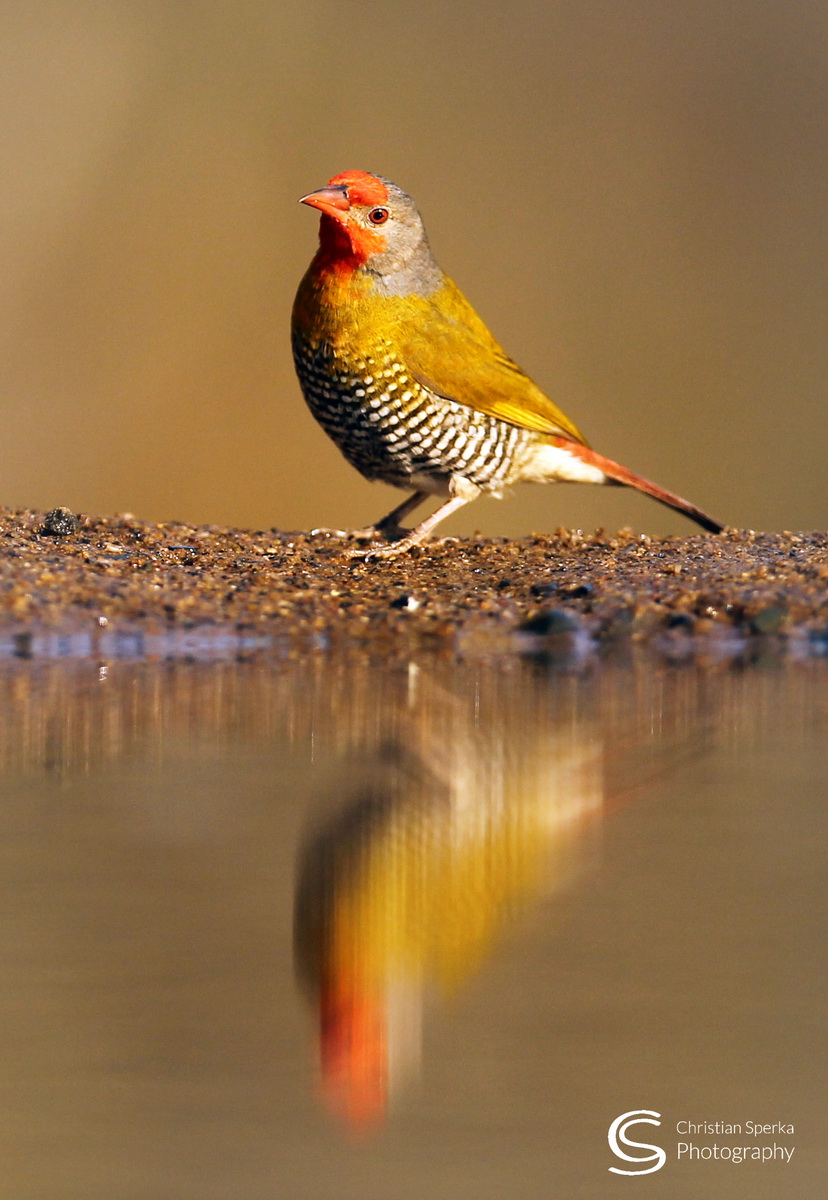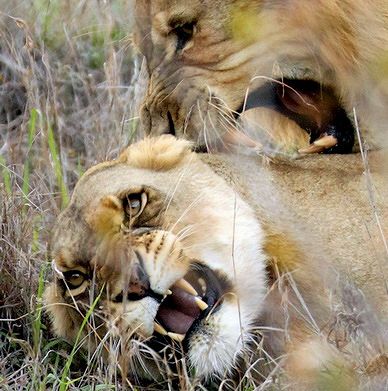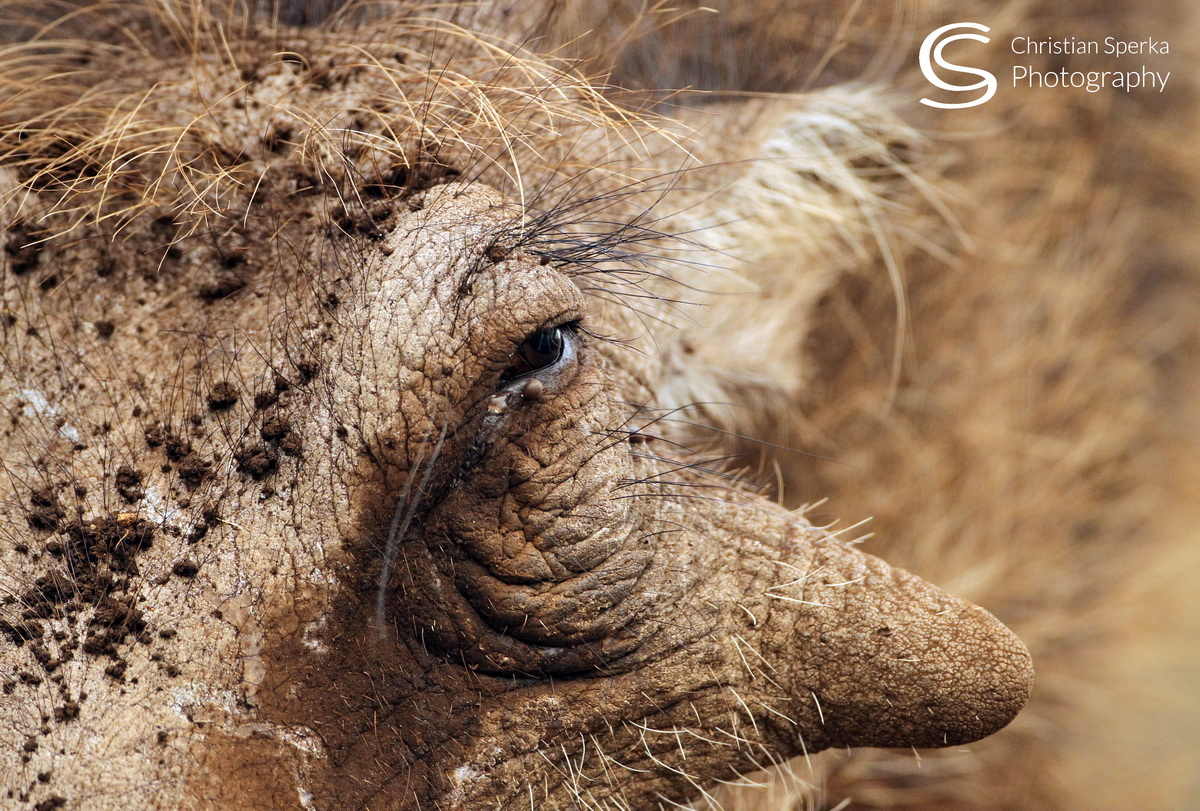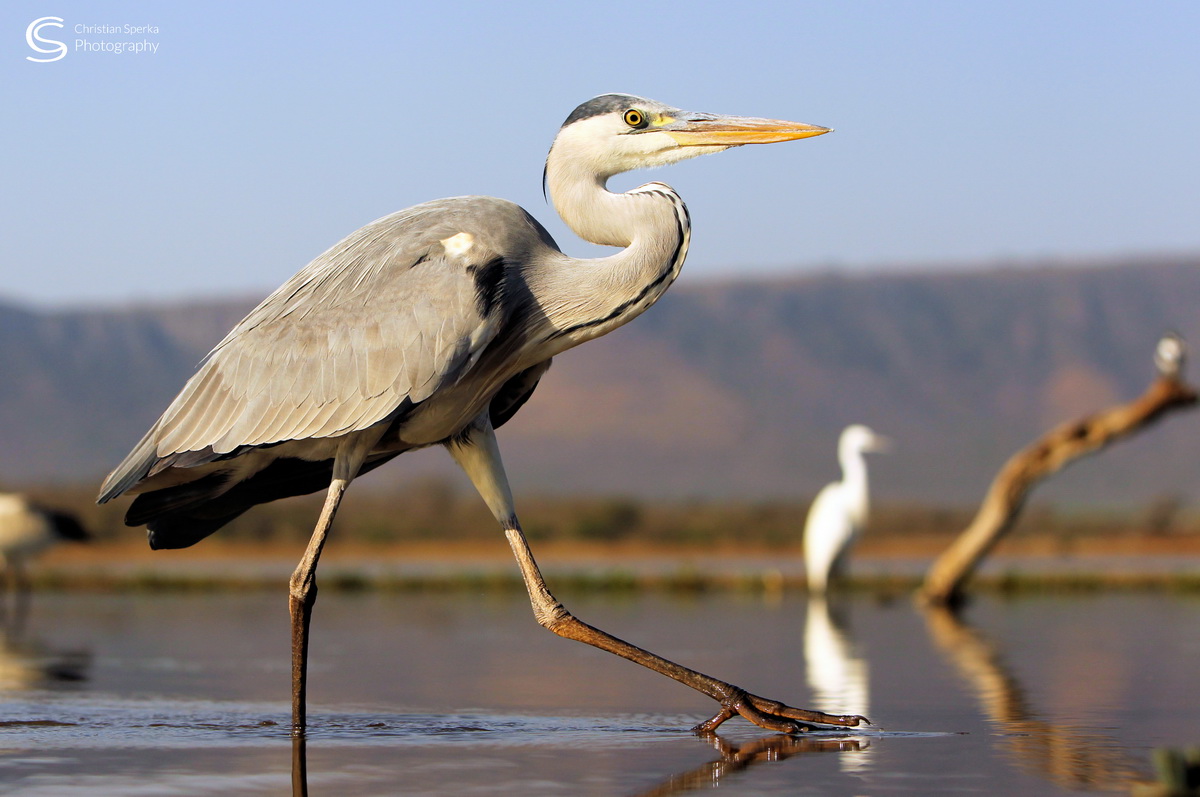
… from, where this picture came from. Stay tuned …
Well, this title might be a bit misleading 🙂
When I left Thanda House this afternoon for a quick visit to friends on a neighbouring reserve, I left Thanda’s two Cheetah boys in charge of perimeter security around Thanda House.
As I drove onto the reserve where my friends live, I took pictures of two little White Rhinos at play. 
And when I got back to Thanda a young Elephant bull gave me a rather excited welcome. From the way he reacted to my vehicle, looking at the glands on his forehead and judging from other obvious signs of excitement :-), he may be getting into musth.
Not the regular house cats, not the average kits at play and a rather unusual excited gentleman in front of the house, but another really good afternoon in the African bush!
Thanda Private Game Reserve now offers a new package named ‘Battlefields and Bush‘ in cooperation with a place called Fugitives’ Drift. I went to have a look at this new package-partner and to take a few images which we will be able to use for our advertisement and for our social media messages. I did not have particular expectations as I knew very little of the Anglo-Zulu war of 1879 and I did not have any great interest in the subject before my visit.
But, it was amazing!
The art of storytelling, together with this fascinating part of South Africa’s and Britain’s history, combined with the stunning scenery of the battlefields made this one of my best trips in a long time. The Fugitives’ Drift lodge is very beautifully located on a 5,000ha heritage site. It is very comfortable with excellent food and very good service. 
Below is a picture record of my stay. It documents me experiencing ‘The Day of The Dead Moon‘, which is the title of the story of this war, as it has been recorded, superbly told by David Rattray.
The audio record is available online at http://www.fugitivesdrift.com/shop.
Upon my arrival I was greeted by a Giraffe as I entered the Fugutives’ Drift Heritage Site. The Isandlawna mountain, which plays an important role in this story, is visible in the background.
From a high-point on the reserve one gets an excellent view down to the Buffalo River, the border between Natal and Zululand.
What a sunset on my first evening!
Mphiwa Ntanzi was the most excellent guide and story teller for the visit to the Isandlwana Battelfield on the second day of my stay.
The Battle of Isandlwana was the first major confrontation in the Anglo-Zulu war. On 22 January 1879, midday – in a very hot and humid summer climate and during an eclipse of the sun (which the Zulus call ‘The Day of the Dead Moon’) – the Zulu Nation won its greatest victory in this war and the British Empire experienced its most devastating defeat. Of the 1,412 British soldiers at the start of the battle only 55 survived. A disciplined army of over 20,000 Zulu warriors was victorious. The British camp was on the left-hand slope of the mountain. The viewpoint -from which this image was taken – was the ridge, from which the main body of the Zulu army moved towards the mountain and attacked the British position.
Just imagine how you would feel to be one the British soldiers (who were in average around 5’2″-5’4″ tall) standing in the high grass (which at the time was up to 6′ high) listening to the war cries and shield-bashing of 20,000 Zulu warriors advancing on you. And remember it was quite dark on that day as the moon blocked out part of the sun around the time of the battle.
This picture shows some of the markers and memorials of British graves on the battlefield of Isandlawana…
… and this is an image of the memorial to the fallen Zulus. It represents a Zulu necklace, which is awarded to a Zulu warrior for exceptional valour in battle. It is arranged in a horn formation, which symbolizes the traditional attack structure of a Zulu army.
The ‘Day of the Dead Moon’ came alive when Mphiwa told us the story as we were sitting in the shade of the tree on the edge of the battlefield. It was a very moving story, masterly presented.
In the late afternoon (on the same day – 22 January 1879), and during the subsequent night, the British fought one of the most heroic battles in history (this story is the basis for the famous film ‘Zulu’). As we visited this site, where a mere 137 men defended the small mission station at Rorke’s Drift against thousands of Zulus, Doug Rattray was telling us the story of the second battle of this historical day. Only 16 of the British soldiers died in this fierce encounter. Victoria crosses were awarded to 12 of the British for their bravery, more than in any other battle in history. Doug’s excellent storytelling skills turned this afternoon into much more than just another visit to a historical site.
I also took a walk to the Buffalo River at Fugitives’ Drift, where some of the survivors from the Isandlwana disaster crossed on their flight from the pursuing Zulus at the same time as the Zulus started their assault on Rorke’s Drift. Dickon, our guide on this walk, told us the gripping story of the British soldiers who died in the attempt to save the Regimental Queens Colours. Two more Victoria crosses were awarded for bravery on this occasion.
It was great to hear all the stories, especially because the three guides always tried to explain the British view and the Zulu view of these tragedies.
As I left Fugitives’ Drift I was certain that I will be back. If you are interested in history and if you enjoy stunning scenery, then Fugitives’ Drift should be part of your agenda when visiting KwaZulu Natal.
All pictures: Christian Sperka Photography (C) 2015
Links:
http://www.thanda.com/packages/battlefields-bush.htm
http://www.fugitivesdrift.com
http://www.anglozuluwar.com
http://www.fugitivesdrift.com/shop
http://www.thanda.com
http://www.sperka.com
I spent another five very enjoyable days at Pakamisa Private Game Reserve and did quite a bit of photography work.
These are only a few of the images I took during my stay!
Photo shooting Arabian Horses,
… taking images of riders cantering on the reserve,
… capturing birds in Pakamisa’s beautiful gardens,
… working with Pakamisa’s kitchen team on pictures for new menu items,
… photographing wildlife on game drives and
…. last but not least capturing the beauty of Pakamisa itself.
Thanda (my South African work place and home) and Pakamisa are my two favorite places in Africa!
For more information on Pakamisa go to www.pakamisa.com.
Yesterday I went to Nsumo Pan at Mkhuze Game Reserve. I wanted to evaluate if this large pan system with its well positioned hides is a good place for excursions with Thanda’s ‘serious photographer’ guests.
Judge for yourself!
I enjoyed the seven hours photo session which included a lot of water birds, a Hippo mum with her small calf out of the water, an African Jacana which used a Hippo as a mid-pan-island, and a Slender Mongoose posing for the camera (a very rare sighting).
In connection with the khMasinga hide (I will post some recent images from this hide, soon) I think this natural pan will work well for ‘serious photography’ guests as long as they have a 500mm+ lens and if they are also interested in birds. For birding enthusiasts it is a paradise – even without pictures.
Enjoy the gallery!
In case you are interested here all the 27 different species I have seen on that day:
Hippos * | African Fish-Eagle * | African Openbill | Spur-winged Goose * | Egyptian Goose * | Nyala * | Impala | Blue Wildebeest | African Darter | African Jacana * | Nile Crocodile | Black-winged Stilt * | Brown-hooded | Kingfisher * | Warthog | Pink-backed Pelican * | Great White Pelican * | Red Duicker | Cattle Egret |Great Egret | Grey Heron | Red-billed Teal | Greater Flamingo | Water Monitor * | Terrapin | African Spoonbill | Slender Mongoose * | Goliath Heron * | * = good photographic condition/distance
During my last time off-work I spent one day in KwaZulu Natal’s most famous National Park, the Hluhluwe-Imfolzi Game Reserve.
I packed all my long lenses, as animals in National Parks are often further away then on Thanda, where we can drive off-road to get closer. In a National Park one has to stay on the roads. The day turned out to be very windy, so I saw almost no general game and very few birds. But most of the “big ones” made their appearance.
Just after I entered the park I drove by a Lion kill sighting (in the thick bush off the road), just as a White Rhino walked by. A herd of Cape Buffalo stared at me near Hilltop Camp as I passed quite close to them. I had many White Rhino sightings (with a lot of ticks on all the Rhinos :-)). Two Elephant bulls strolled up a hillside far away (work for my 500mm lens!) and finally I got to see a few Impalas.
As the sun started to set I watched a Baboon family at their daily grooming ritual and then took a few scenery sunset shots before I left the park.
All in all a productive and relaxing day, despite the wind. I hope you will enjoy this online-image-gallery!
A few images of one of my favorite birds – Scarlet-chested Sunbird – I took them this weekend on Pakamisa.
It was an interesting drive from the Indian Ocean up the Zululand Heritage Route 66 to the Swaziland Border.
I had not chosen the best day for the drive as some of the heritage sites were closed on Saturdays, but it was still a worthwhile experience. I will be back on a weekday to look at the sites I have missed this time.
After my visit to Amatigulu Game Reserve and a canoe tour on the Amatigulu river’s estuary (I will blog about that visit in a few days) I drove to the town of Eshowe …
There I had a quick look at the Fort Nongqayi Museum Village and …
…I took a long walk into Dlinza Forest Nature Reserve with its aerial boardwalk. It was rather late in the afternoon and I did not see a lot of birds, but I still enjoyed the walk in the forest.
I stayed overnight at Eshowe Guest House, which can only be recommended for any stay in Eshowe.
The next day I continued north passing Melmoth to the Ophathe Game Reserve, which was also closed – nobody at the gate :-(.
On my way to Ulundi I crossed the White Mfolozi River and then…
…. I stopped at the Battle of Ulundi Memorial. It commemorates the last battle in the Anglo Zulu War of 1879. This battle effectively ended the rule of King Cetshwayo and the independence of the Zulu kingdom. I was very keen to visit the KwaZulu Cultural History Museum in Ulundi – which includes Ondini, a recreation of King Cetshwayo’s residence – but it was not open on weekends 😦
Pushing north I crossed the Black Mfolozi River and drove into Nongoma, the Royal Capital of Zululand. The Royal Family including King Zwelithini lives there in no less than six royal residences in and around the town. It was the busiest Zululand country town I have experienced so far :-). It took me over twenty minutes to cross the center of town – people, cars, cows everywhere …!
My road map showed the complete route 66 being a tar-road. But that must have been wishful thinking on the map maker’s part. For quite a stretch the road was rough gravel and I was glad that my Toyota Fortuner handles these sort of roads well.
I encounter many cows on route, all but one of them alive :-). And as I was driving during the day it was no problem to drive around those slow and rather stupid creatures!
In afternoon I arrived at Pakamisa Game Reserve (near Pongola) and enjoyed a beautiful evening overlooking the Rolling Hills of Zululand.
All in all these were two excellent days. Learning more about Zululand, the people and the history helps me to be a better guide!